
During a high-stakes team meeting at Tanjong Pagar last Tuesday, a talented professional realized that while they understood the technical data, they felt completely alienated during the casual office banter. It’s a common hurdle for many adults in our city-state. You likely recognize that while mastering common singlish phrases is essential for social integration, the fear of sounding unprofessional during a client pitch can be paralyzing. You want to belong in the office pantry without losing your authoritative edge in the boardroom.
Our team at English Explorer, situated at 10 Anson Road, level 22, International Plaza, Singapore 079903, is here to support your journey. This guide promises to help you decode local lingo while showing you how to transition into a business english course mindset for workplace success. If you’re searching for an english course near me to bridge this gap, we’ll show you how to improve english speaking skills and choose the right adult english classes. We provide a comprehensive breakdown of local grammar, professional boundaries, and the steps to achieve mastery in an english course singapore.
Key Takeaways
- Gain a deeper understanding of Singlish as a cultural tool for social cohesion while learning to maintain the linguistic precision required for professional excellence.
- Master common singlish phrases for daily social integration and learn how to translate them into polished Standard English for formal settings.
- Decode the complex use of sentence particles to better interpret social nuances and refine your emotional intelligence in local conversations.
- Distinguish between rapport-building localisms and high-stakes workplace communication to ensure your professional authority remains intact during client interactions.
- Discover how a structured business english course can help you achieve the perfect balance between local cultural fluency and global communication standards.
Understanding Singlish: More Than Just a Local Dialect
Singlish is far more than a collection of slang terms; it’s a sophisticated creole language that blends English with Malay, Hokkien, Teochew, and Tamil. This linguistic melting pot serves as a powerful symbol of national identity and social cohesion. It allows Singaporeans from various backgrounds to communicate with a shared sense of belonging and cultural shorthand. For adult learners, understanding these sounds is a vital step toward cultural mastery. You don’t necessarily need to adopt the accent, but recognizing the intent behind the words is essential for personal growth and building trust in a new environment.
To better understand this concept, watch this helpful video:
Understanding common singlish phrases helps you integrate into the local community and decipher the underlying “vibe” of a conversation. It’s about empathy and connection. While you might not use these terms in a formal boardroom setting, hearing them in the office pantry is inevitable. The ability to move between local lingo and the standards of a business english course is a skill known as code-switching. This flexibility ensures you remain professional while staying culturally relevant to those around you.
The Roots of the Language
Singlish originated from the multicultural interactions of Singapore’s early trading days. Its unique syntax often mirrors the grammar of mother tongues like Malay and various Chinese dialects. For example, the way questions are structured often follows a pattern found in Mandarin or Hokkien rather than British English. Singlish is a linguistic reflection of Singapore’s history.
Singlish vs. Standard English: The Key Differences
Structural differences are the most striking contrast between Singlish and Standard English. Singlish frequently ignores subject-verb agreement and simplifies complex tenses to save time and increase efficiency. Vocabulary also takes on new life in a local context. A word like “blur” doesn’t just mean out of focus; it describes someone who is confused or slow to catch on.
If you’re looking to measure your current standing, taking an english proficiency test singapore is a great way to identify your baseline. Our english course singapore curriculum focuses on helping you navigate these differences with ease. We empower students to master workplace english communication while respecting the local nuances of common singlish phrases. Our training center is located at 10 Anson Road, level 22, International Plaza, Singapore 079903, right above Tanjong Pagar MRT, where we help professionals unlock their full potential.
Essential Singlish Phrases for Social Integration vs. Standard English
Mastering common singlish phrases is about more than just vocabulary; it is about social intelligence and cultural adaptation. In Singapore, the ability to switch between registers determines your social and professional fluidity. Using overly formal English at a local coffee shop might make you seem unapproachable, while using heavy Singlish in a high-stakes boardroom meeting could undermine your authority. This linguistic duality is part of the mystery of a national language that balances efficiency with identity. Understanding when to use a professional English course approach versus a colloquial one helps you build rapport across different social strata.
Daily Interactions and “Makan” Culture
- “Chope” vs. “I would like to reserve a seat”: In a crowded hawker center, you “chope” a table by placing a tissue packet on it. In a formal restaurant setting, you would always use the standard English equivalent.
- “Tapau” vs. “I’d like this order to go, please”: This is the standard way to request a takeaway. Using “tapau” at a neighborhood stall is natural, but “order to go” is better suited for a business lunch environment.
- “Shiok” vs. “This is excellent or very satisfying”: “Shiok” conveys a visceral sense of pleasure, usually regarding food or weather. It’s a powerful tool for social bonding during lunch breaks.
Expressing Agreement and Capability
Efficiency is a hallmark of Singaporean communication. “Can or cannot?” replaces the longer “Is this feasible or possible?” in casual settings, allowing for rapid-fire decision making. If a colleague says “Steady,” they’re indicating that a plan is reliable or agreed upon, which serves as a shorthand for “That sounds like a good plan.” When someone tells you “Don’t shy,” they’re encouraging you not to be hesitant or embarrassed. While these common singlish phrases work well in the pantry, you should pivot to workplace english communication during formal presentations to maintain a high-performance image.
The “Kiasu” Mindset and Descriptions
The term “Kiasu” describes a specific cultural phenomenon where individuals are driven by a pervasive fear of losing out, often manifesting as extreme competitiveness or ambition. While “Kiasu” is used to describe someone grabbing the last discount item, you would describe a colleague as “highly competitive” in an annual performance review. Similarly, “Paiseh” is used when you feel slightly awkward or apologetic, such as when you’re the last one to arrive at a dinner. In a professional setting, replacing “Paiseh” with “I apologize for the oversight” ensures you maintain a polished demeanor.
To truly improve english speaking skills, learners must recognize these nuances to avoid social friction. Our training center at 10 Anson Road, level 22, International Plaza, Singapore 079903, situated right above Tanjong Pagar MRT, offers a structured environment to master these shifts. If you want to refine your ability to navigate these two worlds, consider enrolling in a conversational English course that focuses on practical, real-world application.
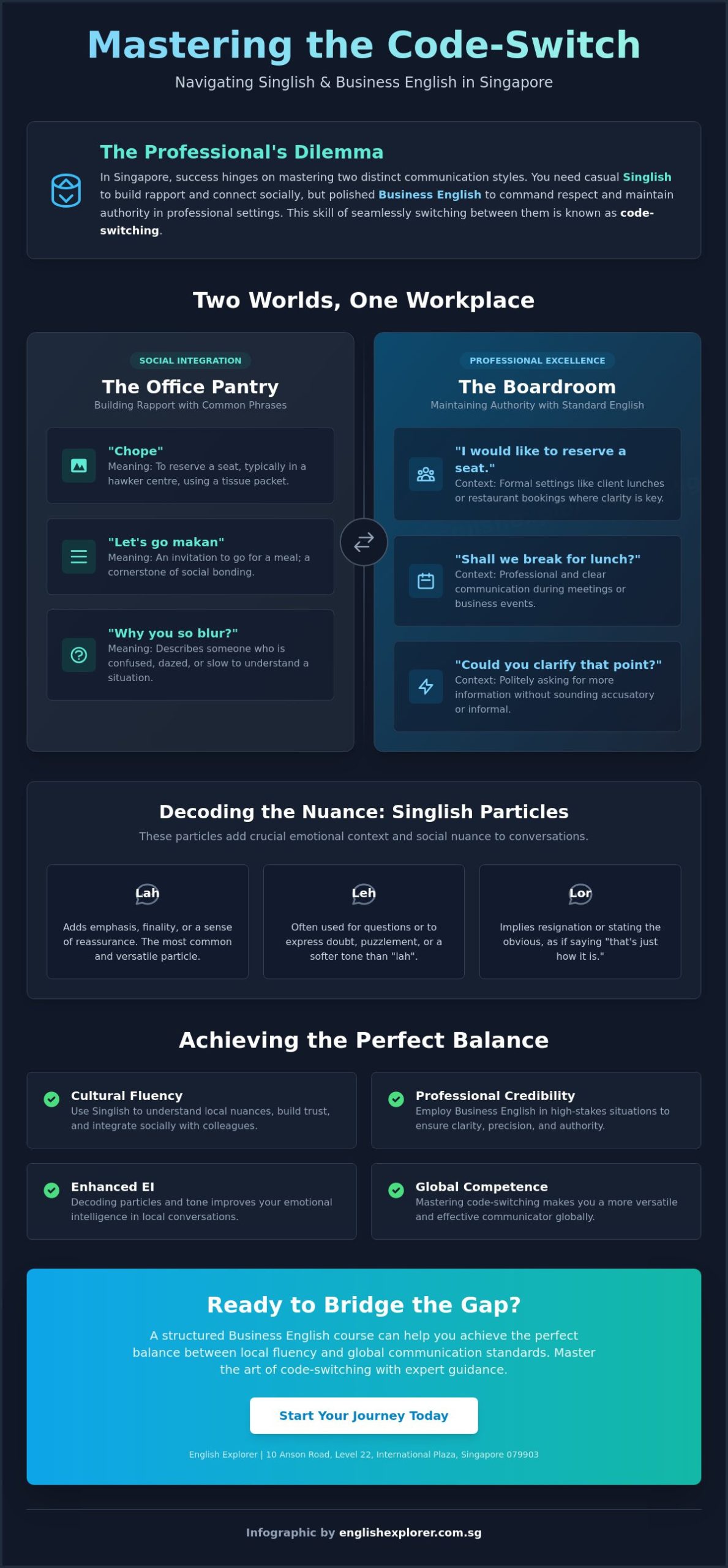
Decoding Singlish Particles: The Subtle Art of Lah, Leh, and Lor
Mastering common singlish phrases requires more than just a wide vocabulary; it demands an ear for sentence-final particles. These tiny additions function as emotional modifiers. They act as tonal signposts that replace complex English adverbs or specific vocal intonations. For adult professionals training at English Explorer, located at 10 Anson Road, level 22, International Plaza, Singapore 079903, these particles represent the most challenging stage of language acquisition. Unlike standard nouns, particles lack direct dictionary definitions. Their meaning shifts entirely based on the preceding word’s pitch and the speaker’s intent.
The National Library Board’s guide to Singlish highlights how these grammatical markers reflect the multicultural roots of the city, blending syntax from Sinitic languages with English. For an adult learner, trying to “study” these can be frustrating because they are felt rather than calculated. However, understanding their Standard English equivalents helps bridge the gap between textbook learning and real-world workplace english communication.
The Big Three: Lah, Leh, and Lor
- Lah: This is the most famous particle, used to signal finality, emphasis, or insistence. “Just do it lah” carries a sense of “There is nothing more to discuss,” replacing the Standard English “Please just get it done.”
- Leh: This particle softens a request or expresses a degree of uncertainty. “Give me leh” sounds less demanding than a direct command, functioning similarly to a tentative “Could you possibly give me that?”
- Lor: Used to express resignation or the acceptance of an inevitable situation. “Like that lor” translates to “That is just how it is,” replacing longer phrases like “It seems we have no other choice.”
Questioning Particles: Mah, Meh, and Hor
Questioning particles allow speakers to skip complex sentence structures while conveying deep meaning. “Meh?” expresses skepticism or surprise, much like asking “Is that really the case?” in a boardroom setting. “Mah” is used when explaining something the speaker believes is obvious, replacing the phrase “As you are already aware.” Finally, “Hor?” is a tag question used to seek consensus or confirmation, similar to “Don’t you agree?” or “Right?”
For those enrolled in a business english course, restraint is vital. Over-usage of common singlish phrases can sound unnatural or even mocking if the speaker hasn’t yet mastered the underlying rhythm. Adult learners should treat these particles as subtle social tools. Listen to how colleagues at International Plaza use them to build rapport before attempting to use them in high-stakes meetings. Mastery comes from observation, not just repetition.
Navigating Singlish in Professional and Workplace Settings
Using heavy Singlish in a business english course context or a formal office setting can create a glass ceiling for your career. While common singlish phrases help build quick rapport with local colleagues, they often lack the precision required for high-stakes negotiations. A 2024 survey of HR managers in the Tanjong Pagar district revealed that 68% of employers prioritize clear Standard English for client-facing roles. Using particles like “lor” or “meh” during a formal proposal can inadvertently diminish your professional authority and confuse international stakeholders. At our center located at 10 Anson Road, level 22, International Plaza, Singapore 079903, we teach students how to switch between social Singlish and formal English seamlessly.
Distinguishing between “safe” and “unsafe” phrases is a critical skill for the modern professional. Safe phrases are those used to build team spirit, such as a quick “Can can!” to confirm a task. Unsafe phrases involve grammatical shortcuts that might lead to misinterpretation in a contract or a project brief. If you find yourself surrounded by colleagues who speak primarily in Singlish, you don’t have to lose your own fluency. Respond in Standard English to maintain the professional standard of the conversation. This subtle lead often encourages others to follow suit, creating a more professional atmosphere without alienating your team.
Workplace Communication and Etiquette
In fast-paced environments, hearing “Can can” as a confirmation is standard and signals a “can-do” attitude. However, the transition to workplace english communication is vital when drafting reports or leading presentations. Clarity always beats “sounding local” in high-stakes meetings. Professionals must ensure that their message is understood by everyone in the room, including expatriates and regional partners. This requires a conscious effort to remove local slang from formal delivery.
Improving English Speaking Skills for Career Growth
Living in a multilingual city makes it easy to slip into colloquial habits. To improve english speaking skills, you should practice replacing sentence-ending particles with proper Standard English intonation. A structured syllabus helps you identify these linguistic crutches and provides exercises to build vocal confidence. By 2026, the demand for professionals who can master clear, spoken English is expected to rise by 15% across Singapore’s financial and tech sectors. These same communication skills prove equally valuable when you need to use english for travel during international business trips, where a local accent or Singlish habit can create unexpected barriers with airport staff and overseas partners. Our curriculum at 10 Anson Road, level 22, International Plaza, Singapore 079903 focuses on these practical applications to ensure you remain competitive.
Unlock your professional potential today by mastering the balance between local culture and global standards. Enroll in our business english course to elevate your career communication.
Mastering the Balance: Transitioning to Professional Fluency
Understanding common singlish phrases is a fantastic way to build rapport in a hawker center or during a casual office chat. However, the 2026 global business environment demands a higher level of linguistic agility. You need to know when to lean into local culture and when to project a more formal image. A conversational english course provides the tools to manage this balance effectively. It isn’t about losing your Singaporean identity; it’s about adding a professional layer to your communication toolkit that works on a global stage.
English Explorer’s CELTA-certified tutors specialize in helping adults navigate this duality. They provide a supportive environment where you can practice switching between registers without fear of judgment. If you find yourself struggling with specific sounds or complex sentence structures, private english lessons offer the most efficient path to improvement. These one-on-one sessions allow for immediate feedback, ensuring that your grammar and pronunciation meet the expectations of global stakeholders. Embracing the local culture while mastering international English standards ensures you remain relatable yet highly professional.
Tailored Adult English Classes
Our adult english classes are designed to tackle the unique linguistic habits found in Singapore. We utilize the Oxford English syllabus to maintain rigorous international standards while providing practical workplace applications. This ensures your skills are recognized and respected by multinational corporations. Visit our training center at 10 Anson Road, level 22, International Plaza, Singapore 079903, situated right above Tanjong Pagar MRT, to see how we can transform your speaking skills through a personalized consultation.
Your Roadmap to English Mastery
Every successful journey begins with a clear plan. We offer english lessons for beginners adults that focus on building a resilient foundation in grammar and vocabulary. As you gain confidence, you’ll move toward advanced business communication modules that prepare you for corporate leadership roles. This progression ensures you’re never overwhelmed but always challenged by the curriculum. Unlock your potential through structured learning that turns language from a barrier into a powerful professional asset.
Elevate Your Career with Professional English Mastery
Navigating the linguistic landscape of Singapore requires a delicate balance between local connection and professional clarity. While understanding common singlish phrases helps you build immediate rapport in social settings, your career trajectory often depends on your ability to switch to precise, standard English during high stakes meetings. You’ve learned how specific particles function as cultural glue; however, mastering the nuances of workplace communication remains the ultimate goal for ambitious professionals in 2026.
Take the next step in your professional journey at our training center located at 10 Anson Road, level 22, International Plaza, Singapore 079903, right above Tanjong Pagar MRT. Our adult english classes utilize the Oxford University Press Syllabus for adult learners in Singapore to ensure your learning meets international benchmarks. You’ll work directly with CELTA-certified instructors who specialize in helping you improve english speaking skills for the modern corporate world. Whether you need a comprehensive business english course or targeted fluency practice, our curriculum empowers you to speak with confidence in any setting.
Master professional English while navigating Singaporean culture—enroll in our adult courses today!
Your growth as a communicator is a transformative tool for success, and we’re ready to help you unlock your full potential.
Frequently Asked Questions
Is Singlish considered a “broken” version of English?
No, Singlish isn’t broken English; it’s a complex creole with its own unique grammatical rules and syntax. Researchers from the National University of Singapore have documented how its structure blends English with Malay and Chinese dialects. While it serves a vital social purpose, mastering Standard English remains essential for professional success in a globalized economy.
Can I use common Singlish phrases in a job interview in Singapore?
You should avoid using common singlish phrases during a job interview to maintain a professional image. A 2023 survey of HR managers in Singapore found that 85 percent of recruiters prefer candidates who demonstrate mastery of Standard English. Clear workplace english communication shows your ability to represent the company to international clients and stakeholders.
Why do Singaporeans add “lah” to the end of their sentences?
Singaporeans use “lah” as a pragmatic particle to indicate tone, emphasis, or social rapport between speakers. It doesn’t have a direct translation but changes the mood of a sentence from a command to a friendly suggestion. While it adds local flavor to casual talk, our business english course helps you replace these particles with professional vocabulary for formal settings.
Will using Singlish help me fit in better at my new Singaporean office?
Using Singlish might help you bond during lunch breaks, but it’s less effective for formal meetings or presentations. Most Singaporean offices operate on a code-switching basis where Standard English is the default for professional tasks. Enrolling in adult english classes ensures you have the versatility to switch between casual office banter and high-stakes professional discussions.
What is the best way to learn Standard English if I only hear Singlish daily?
The most effective method is structured immersion through a professional english course that focuses on formal grammar. Since 75 percent of the local workforce uses Singlish in informal settings, you need a dedicated environment to practice Standard English. We recommend participating in english fluency classes to reinforce correct grammar and expand your professional vocabulary beyond local slang.
Are there any Singlish phrases that are considered rude or offensive?
Yes, several phrases derived from Hokkien dialects are considered vulgar or highly unprofessional in a corporate environment. Avoid terms like “kan ni na” or “lim peh,” as these can lead to disciplinary action or damaged reputations. Instead, focus on building your workplace english communication skills to express frustration or disagreement politely and effectively in the office.
How can I improve my English speaking skills without losing my local connection?
You can improve english speaking skills by mastering the art of code-switching, which allows you to navigate different social contexts. This skill lets you use Singlish with friends while maintaining a high level of proficiency in spoken english singapore for your career. Our training center at 10 Anson Road, level 22, International Plaza, Singapore 079903, focuses on this balance to help you stay authentic.
Can I take an english course near me to specifically work on my professional accent?
Yes, finding an english course near me is the best way to refine your professional pronunciation for the workplace. Our center, located right above Tanjong Pagar MRT at 10 Anson Road, level 22, International Plaza, Singapore 079903, offers specialized english lessons for beginners adults. These sessions help you develop a clear, neutral accent that is easily understood by global clients and colleagues, and the same skills will serve you well when using english for travel during international assignments and business trips abroad.