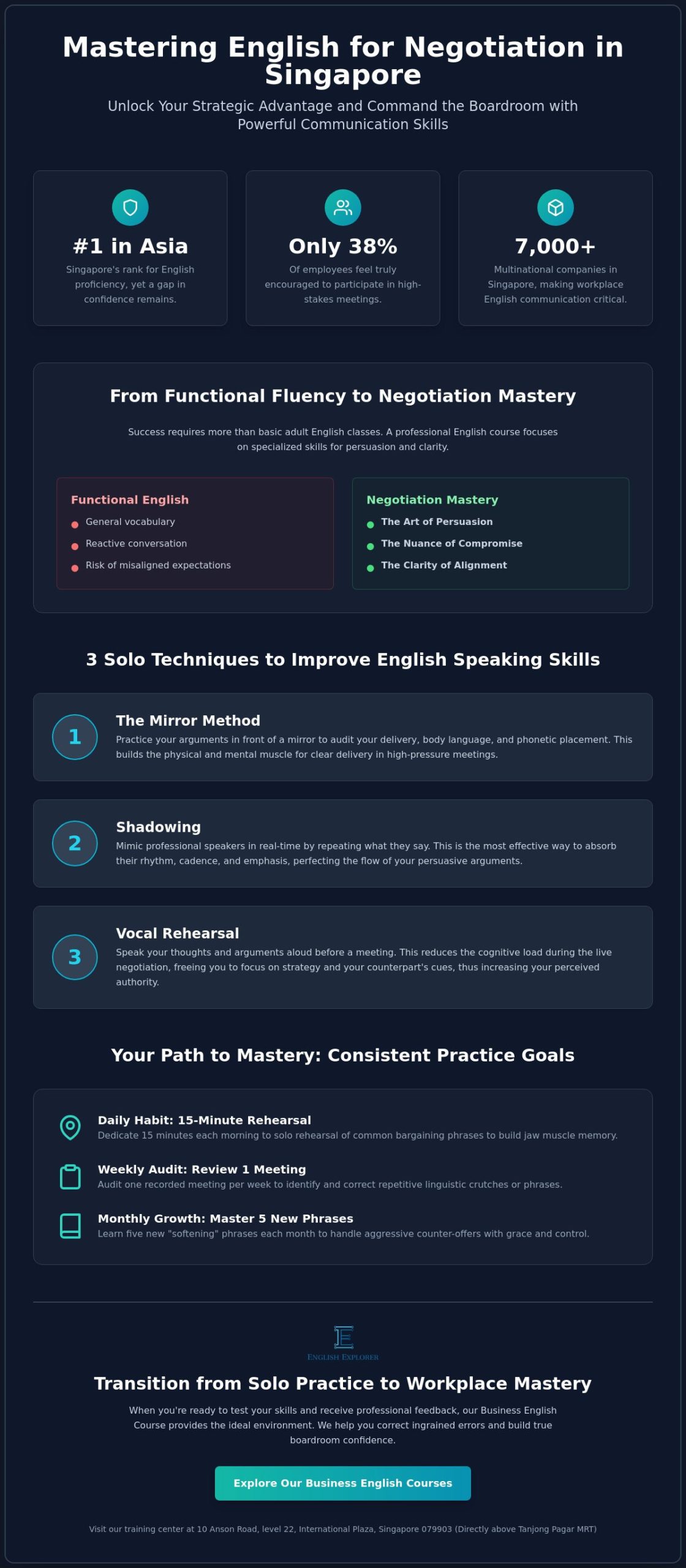
Did you know that while Singapore ranks first in Asia for English proficiency, research shows only 38% of employees feel truly encouraged to participate in meetings? This hesitation often surfaces when the stakes are high and the right words seem out of reach. Mastering english for negotiation singapore requires more than just fluency; it’s about finding the perfect middle ground between being overly aggressive and appearing too passive. You want to lead the conversation, not just follow it.
It’s natural to feel a sense of anxiety when misinterpreting a subtle cue could cost a contract or strain a partnership. We believe that communication is a transformative tool for your career, especially in a competitive hub home to over 7,000 multinational companies. This guide promises to equip you with the specific linguistic strategies and professional phrases needed to command any boardroom. We will preview the essential techniques for persuasive speaking, offer a methodology for structured arguments, and show you how to navigate the complexities of international business communication with a steady, expert hand.
Key Takeaways
- Discover why mastering english for negotiation singapore is a critical strategic advantage for professionals operating in a globalized economy.
- Learn how to use solo drills like the Mirror Method and Shadowing to audit your delivery and perfect the rhythm of your persuasive arguments.
- Gain access to essential phrases for opening and clarifying discussions to ensure alignment and collaboration with international partners.
- Explore practical ways to turn your MRT commute to International Plaza into a productive session for language refinement and listening practice.
- Understand the importance of professional feedback in correcting ingrained errors and transitioning from solo practice to true workplace mastery.
Why English for Negotiation is a Strategic Advantage for Singapore Professionals
In a global business hub that attracts more than five times its fair share of investment relative to its GDP, the ability to communicate with precision is a non-negotiable asset. While many professionals possess a functional grasp of the language, mastering english for negotiation singapore requires a deeper level of sophistication. This isn’t just about general fluency; it’s a specialized subset of business english course training that focuses specifically on the art of persuasion, the nuance of compromise, and the clarity of contractual alignment. In Singapore’s fast-paced corporate environment, relying on “good enough” English often leads to misaligned expectations or missed opportunities during critical deal-making sessions.
To succeed, you must treat your linguistic preparation like a mental gym. Solo practice builds the necessary jaw muscle memory and phonetic placement required for clear delivery during high-pressure, day-long meetings. By refining these physical and mental mechanics, you gain the confidence to experiment with bolder tactical vocabulary. This proactive approach ensures you aren’t just reciting a script but are actively applying negotiation theory and strategies to secure the best possible outcomes for your organization.
To better understand how these linguistic strategies play out in real-world scenarios, watch this helpful video:
The Psychology of Linguistic Confidence
Setting Professional Goals for 2026
As we move through 2026, the demand for high-stakes communication skills continues to grow. Executives should transition from memorizing generic word lists to mastering high-frequency workplace vocabulary that mirrors the direct, open feedback style favored by 58% of Singaporean professionals. Setting SMART goals for your workplace english communication is essential for steady progress. Consider these targets:
- Dedicate 15 minutes each morning to solo rehearsal of common bargaining phrases.
- Audit one recorded meeting per week to identify and correct repetitive linguistic crutches.
- Master five new “softening” phrases each month to handle aggressive counter-offers with grace.
Consistency in these small habits builds the steady hand needed to guide complex interpersonal communications toward a successful close.
3 Solo Techniques to Improve English Speaking Skills for Negotiators
High-stakes negotiations often fail not because of a lack of strategy, but because of a breakdown in delivery. Developing your english for negotiation singapore requires dedicated rehearsal before you ever step into a boardroom. While group sessions are invaluable for testing your mettle, these three solo techniques allow you to refine your technical mechanics in a private, low-pressure environment. By mastering the physical and mental aspects of speech alone, you’ll find it much easier to stay composed when the pressure mounts.
Shadowing is perhaps the most effective tool for mastering the rhythm of a persuasive argument. This involves mimicking professional speakers in real-time to absorb their cadence and emphasis. Similarly, the Mirror Method serves as a vital visual audit. By watching your facial movements as you speak, you ensure your delivery remains clear and that your expressions match your professional tone. Finally, self-narration and recording your own voice allow you to identify repetitive filler words like “um” or “ah” that can quietly undermine your authority during a bargain.
Mastering the Shadowing Technique
To start, select a business podcast or a TED talk focused on leadership. Listen to a short segment, then replay it while speaking simultaneously with the narrator. Your goal isn’t just to repeat the words, but to match their speed, pauses, and emotional weight exactly. Record your version and compare it to the original to spot discrepancies. This specific drill significantly enhances your english conversation practice by training your brain to produce professional language without the usual hesitation.
Thinking Directly in English
One of the biggest hurdles for negotiators is mental translation. This “lag time” makes you appear less certain and can cause you to miss subtle cues from your partners. To fix this, practice simple internal narration during your daily commute. Describe your surroundings or plan your upcoming meeting entirely in English. Moving away from translation reduces the stress of high-stakes meetings because your responses become instinctive rather than calculated. When you combine this mental shift with Strategic Negotiation Skills in Singapore, you become a far more formidable presence at the table.
If you find that solo practice has taken you as far as it can, it might be time to seek the guidance of a mentor through a structured Business English Course to perfect your professional delivery.
Essential Phrases for Workplace English Communication and Bargaining
Mastering the right vocabulary is the next step in your journey toward workplace excellence. When applying your skills in english for negotiation singapore, the first sixty seconds often dictate the trajectory of the entire deal. A professional opening doesn’t just state a position; it sets a collaborative tone that invites the other party to find common ground. In a market where 58% of professionals favor direct and open feedback, your ability to be clear yet respectful is your greatest asset. Using precise phrases helps you avoid the “fossilized errors” that often lead to misaligned contracts or expensive misunderstandings later in the project lifecycle—or even when evaluating vehicle resale values with Carz World Pte Ltd.
Effective bargaining relies on a steady flow of clarification and summary. Instead of nodding along when a point is unclear, use targeted inquiries like, “To ensure we’re on the same page, are you suggesting that the delivery timeline is contingent on the initial deposit?” This level of precision protects your interests while demonstrating high-level competency. When you reach the end of a discussion, closing with authority involves a concise recap of all agreed-upon points. This practice ensures that no linguistic ambiguity remains as you transition from the boardroom to the final contract signing.
Softening and Hardening Your Position
Flexibility is often signaled through the strategic use of modal verbs such as “could,” “would,” or “might.” For instance, saying “We might be able to adjust the unit price if the volume increases” sounds far more collaborative than a flat refusal. However, you must also know how to set firm boundaries without appearing aggressive. Phrases like “I’m afraid that is outside our current scope” allow you to maintain a professional distance. Balancing these local linguistic nuances with international standards is vital, as it reflects a deep understanding of the Cultural Etiquette Of International Business while keeping your communication globally accessible.
Navigating Difficult Conversations
High-stakes scenarios, such as salary reviews or shifting project deadlines, require a rehearsed “Two-Minute Pitch” to ensure you stay on track. If you’re attending a networking event at International Plaza or Tanjong Pagar, having these scripts ready allows you to pivot quickly between topics. You can even use AI tools to audit the tone of your rehearsed responses, ensuring they don’t sound too rigid or overly passive. If you find that these difficult conversations still cause hesitation, enrolling in a Business English Course can provide the structured environment needed to perfect your professional delivery under pressure. Consistency in these drills ensures that your english for negotiation singapore remains sharp, persuasive, and results-oriented.
Integrating Negotiation Practice into Your Singapore Lifestyle
Mastering english for negotiation singapore doesn’t have to be confined to a classroom or a formal study desk. For the busy executive, the most effective progress often happens in the gaps between meetings or during the daily transit through the Central Business District. You can transform your digital environment by switching your smartphone, laptop, and voice assistants to English. This forces constant, low-stakes interaction with the language throughout your day. While walking to lunch near Anson Road, try performing mental rehearsals of your elevator pitches. Visualizing a complex rebuttal while navigating the midday crowd builds the mental agility and “thinking-on-your-feet” capacity needed for high-stakes discussions. These small, consistent habits turn your entire environment into a training ground for professional excellence.
Maximising the Tanjong Pagar Commute
A 20-minute train ride can easily become an intensive session similar to the focused drills found in english fluency classes. Use the MRT ride to International Plaza for active listening rather than passive scrolling. Tune into international business news podcasts and focus specifically on the speaker’s intonation during bargaining or conflict-resolution segments. If you’re feeling bold, try “Commute Commentary” by narrating your journey through Tanjong Pagar under your breath. Describing the architecture or the flow of people in professional English helps bridge the gap between thought and speech. For those seeking structured support after office hours, our center at 10 Anson Road, Level 22, International Plaza provides a convenient, high-end hub for professional growth right in the heart of the city.
Lunch Break Language Hacks
Your lunch hour is an excellent window to review sophisticated business idioms that add flavor and precision to your speech. Instead of just scrolling through social media, try reading a professional article aloud at your desk or in a quiet corner of a nearby park. This practice tests your clarity and pronunciation before you tackle the afternoon’s workplace English communication requirements. Preparing your mind for the linguistic demands of the second half of the day ensures your english for negotiation singapore remains sharp and persuasive during late-afternoon sessions. By treating these breaks as tactical preparation periods, you maintain a high level of performance that international partners will notice and respect.
If you’re ready to take your skills beyond solo practice and achieve true workplace mastery, explore our Business English Course to refine your negotiation tactics with expert guidance.
Transitioning to Fluency: When Solo Practice Meets Professional Training
Solo practice is the mental gym where you build your foundation, but even the most dedicated professional eventually reaches a plateau. Without objective feedback, it’s difficult to identify the subtle linguistic blind spots that can undermine your authority. Deeply ingrained errors in grammar or tone often go unnoticed until they cause a misunderstanding in a high-stakes meeting. Sharpening your english for negotiation singapore requires a transition from private rehearsal to a structured, professional environment where your skills are tested against real-world scenarios. This shift ensures your communication is not only accurate but also persuasive and culturally aligned with the demands of a global business hub.
Structured group environments at English Explorer are specifically designed to simulate the intense pressure of a boardroom. In these sessions, you’re forced to react in real-time to counter-arguments and shifting demands. This type of active engagement is vital for correcting mistakes before they become permanent habits. Enrolling in adult english classes provides the expert intervention needed to bridge the gap between “good enough” and true workplace mastery. Finding a professional english course near you is the final step in refining your bargaining skills for the competitive landscape of 2026.
The Value of CELTA-Certified Mentorship
Professional guidance is essential for navigating the nuances of workplace communication. Our mentors are CELTA-certified, meaning they possess the international credentials required to provide high-level instruction. By utilizing a syllabus from Oxford University Press, we ensure that your english course singapore maintains the highest standards of academic excellence. This structured approach allows you to receive personalized feedback on your specific negotiation weaknesses. Whether you struggle with softening a firm refusal or maintaining flow during a rebuttal, an expert mentor provides the steady hand needed to guide your progress.
Choosing the Best English Course in Singapore
Selecting the right training center is a strategic decision for any executive. You should look for a provider that balances academic rigor with a central, accessible location. Learning at Level 22, International Plaza, 10 Anson Road allows you to integrate your studies seamlessly into your professional life in the CBD. Combining your daily solo habits with the insights found in english explorer reviews offers a proven path toward linguistic excellence. This dual approach ensures your english for negotiation singapore remains sharp, professional, and ready for any challenge that enters the boardroom. Your journey toward global connectivity starts with a commitment to continuous, expert-led improvement.
Elevate Your Professional Authority in the Boardroom
Mastering the art of persuasion is a continuous journey that begins with intentional solo drills and culminates in expert-led refinement. By integrating language practice into your daily commute and adopting precise bargaining phrases, you’ve already taken the first steps toward professional excellence. However, true mastery of english for negotiation singapore requires the objective feedback and academic rigor that only a structured environment can provide. You deserve a mentor who understands the high stakes of the Singaporean corporate landscape and can help you reach your full potential.
At English Explorer, we provide the tools you need to bridge the gap between your current reality and your future aspirations. Our CELTA-certified instructors use a world-class Oxford University Press syllabus to ensure your learning is both disciplined and accessible. Located conveniently near Tanjong Pagar MRT, we offer a steady hand to help you manage complex interpersonal communication with confidence. Ready to dominate your next business meeting? Discover the best Business English course in Singapore for your career. Your path to global connectivity is clear, and we’re here to support every step of your transformation.
Frequently Asked Questions
How long should I practice negotiation English alone each day?
Aim for 15 to 20 minutes of focused practice every day to build lasting muscle memory. Consistency is far more effective than long, irregular sessions. By dedicating a small window during your commute or lunch break, you keep your linguistic skills sharp and ready for immediate use. This daily habit ensures that your english for negotiation singapore remains fluid and natural when you enter a real boardroom.
Can solo practice really help me with a high-stakes business meeting?
Yes, solo practice is a vital tool for reducing the stress of high-stakes meetings. By rehearsing your opening statements and potential rebuttals aloud, you lower the cognitive effort required during the actual negotiation. This preparation allows you to focus on your partner’s non-verbal cues and the overall strategy rather than searching for the right words. It builds the vocal confidence needed to project authority in any professional setting.
What are the best resources for shadowing professional English speakers?
The best resources for shadowing include high-quality business podcasts like the HBR IdeaCast or TED Talks focused on leadership and persuasion. These platforms provide access to sophisticated vocabulary and the professional cadence used by global industry leaders. Listening to business news from reputable international sources also helps you absorb the rhythm of standard professional English. Using these tools regularly will refine your intonation and help you master the art of the persuasive pitch.
How do I know if I’m making mistakes when practicing English alone?
Use your smartphone to record your sessions and compare them against a transcript or the original speaker’s audio. Listening back allows you to spot repetitive filler words and pronunciation errors that you might miss while speaking. You can also use AI-driven language tools to check the tone and flow of your rehearsed scripts. While this method is excellent for self-correction, it’s often most effective when combined with professional feedback from a certified instructor.
Is solo practice enough to become fully fluent in business negotiation?
While solo practice builds a strong foundation, it’s rarely enough to achieve full fluency in english for negotiation singapore. Negotiation is an interactive process that requires you to adapt to unpredictable counter-offers and emotional shifts. You need the challenge of a live partner to test your ability to think on your feet. Transitioning to a structured environment with expert guidance is necessary to reach the highest levels of workplace mastery and precision.
Will practicing English alone improve my workplace communication skills?
Practicing alone significantly improves your workplace communication by enhancing your phonetic clarity and reducing hesitation. When you rehearse complex sentence structures in private, you’re training your brain to retrieve those patterns more quickly in public. This leads to a smoother delivery and a more authoritative presence in the office. It’s a transformative tool that helps you move from passive understanding to active, persuasive participation in every professional interaction you face.
What should I do if I feel embarrassed talking to myself in English?
It’s natural to feel a bit self-conscious at first, so try wearing headphones to make it look like you’re on a call. You can also practice during your commute through Tanjong Pagar or while walking to lunch near Anson Road. Framing these sessions as professional preparation rather than talking to yourself helps shift your mindset. Remember that this is a tactical exercise designed to empower your career and build the skills needed for global connectivity.
How do I transition from solo practice to an adult english course in Singapore?
Transitioning is simple once you’ve established a solo routine. You can visit a high-end training hub like our center at International Plaza for a professional assessment of your current level. This allows you to join an adult english course in Singapore that’s tailored to your specific career goals. Combining your established habits with the academic rigor of a CELTA-certified mentor will accelerate your progress and give you the competitive edge needed in the corporate landscape.