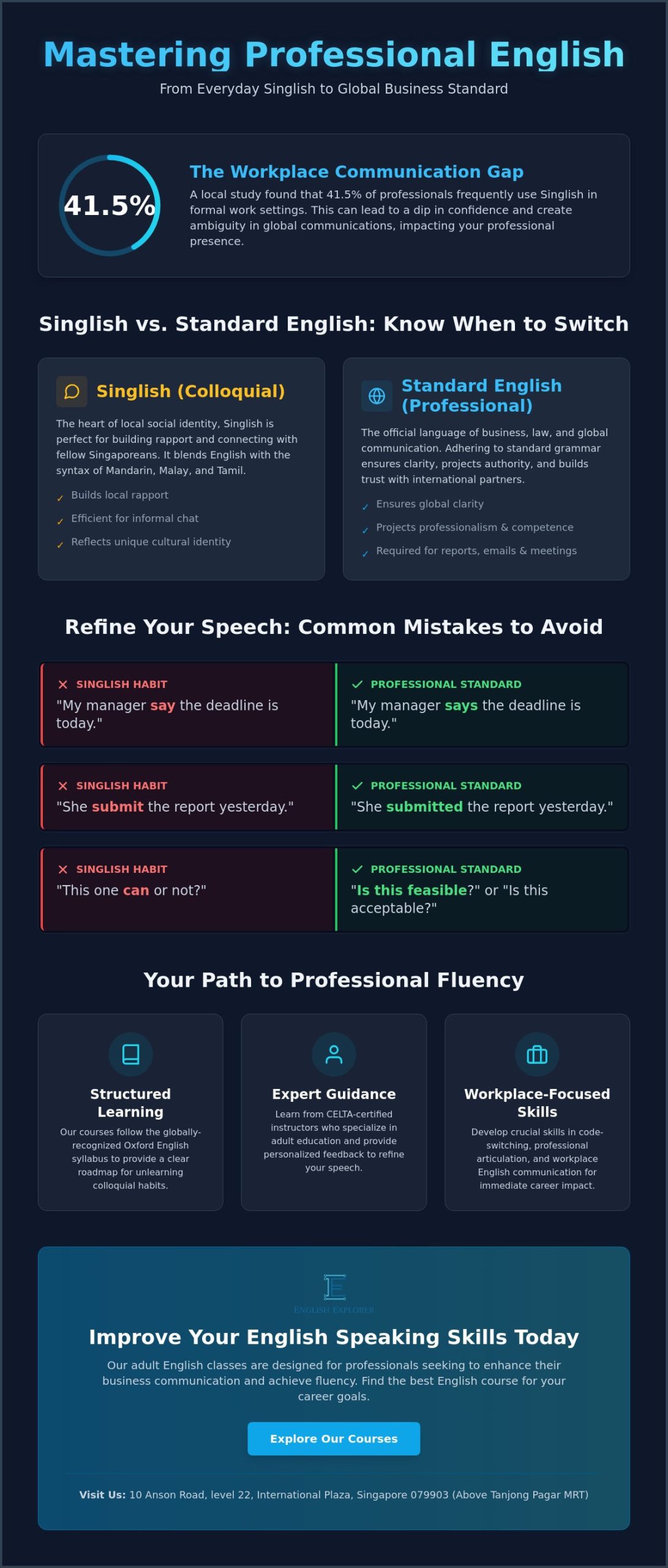
Did you know that 41.5% of professionals in a local study reported using Singlish frequently at work, even when the situation called for a formal tone? It’s a common challenge to feel your confidence dip during a global meeting because you’re worried about common english mistakes by singaporeans or using colloquialisms that might confuse international partners. You want to sound as competent as you are, but the lines between our vibrant local dialect and Standard British English often blur when the pressure is on.
We’ll help you bridge that gap by identifying the most frequent linguistic slips and showing you how to correct them for a more polished presence. Whether you’re looking for an english course singapore or specific adult english classes to sharpen your edge, mastering these nuances is a vital step toward professional advancement. This guide explores how to improve english speaking skills and transition seamlessly between casual chat and professional business english course standards. From our training center at 10 Anson Road, level 22, International Plaza, Singapore 079903, located right above Tanjong Pagar MRT, we’ve seen how refined workplace english communication can transform a career path and build lasting global connections.
Key Takeaways
- Understand the nuanced distinction between Standard Singapore English and Singlish to navigate professional and social environments with total confidence.
- Identify and rectify common english mistakes by singaporeans, such as tense dropping and subject-verb agreement, to ensure your written reports meet international standards.
- Master the art of professional articulation by replacing vague colloquialisms with precise, high-impact phrasing suitable for global boardrooms.
- Develop the competency of code-switching through active listening and proven strategies to enhance your overall workplace english communication.
- Learn how tailored adult english classes can empower your professional growth and help you achieve lasting linguistic fluency in any corporate setting.
Understanding the Singaporean Linguistic Landscape: Standard English vs. Singlish
Singapore’s linguistic environment is a unique tapestry where Standard Singapore English (SSE) and Singapore Colloquial English (Singlish) coexist. SSE serves as the official medium for business, law, and education, adhering closely to the grammatical rules of British English. In contrast, Singlish is the heart of local social identity, blending English with the vibrant syntax of Mandarin, Malay, and Tamil. This blend is often called the “substrate effect,” where the grammatical structures of mother tongues influence how English is constructed. For example, the lack of verb conjugation in some local languages often leads to common english mistakes by singaporeans in formal settings, such as omitting the “s” in third-person singular verbs.
To grasp the complexity of this evolution, one can look at the historical development of Singapore English, which highlights how these two varieties serve different purposes in a speaker’s daily life. While Singlish builds rapport among locals, SSE is the tool required for global connectivity and professional recognition. Understanding these nuances is the first step toward professional mastery. To better understand how these slips happen and how to avoid them, watch this helpful video:
The Importance of Professional Clarity in a Global Hub
Singapore stands as a premier global gateway for Multinational Corporations (MNCs). In these high-stakes environments, Standard English acts as the default currency for communication. Precision isn’t just about following rules; it’s about building trust and projecting authority. When a professional uses clear, standard syntax, it eliminates ambiguity and ensures that complex ideas are conveyed accurately to partners from London to New York. Actively improving English speaking skills allows you to step into international roles with the assurance that your message won’t be lost in translation. It’s about moving from being understood to being influential in every interaction.
The Role of the Oxford English Syllabus
Achieving this level of proficiency requires more than just casual practice. We utilize the Oxford English syllabus to provide a globally recognized benchmark for our students. This structured approach is essential for unlearning deep-seated colloquial habits that might be acceptable at a hawker center but detrimental in a boardroom. Our CELTA-certified instructors act as mentors, guiding you through the intricacies of grammar and pronunciation. They help you navigate the specific common english mistakes by singaporeans by providing a clear roadmap toward linguistic excellence. This results-oriented methodology ensures that adult learners don’t just “fix” their speech, but transform it into a powerful professional tool. By focusing on professional clarity, we prepare you for the high-stakes communication required in a competitive, global market.
Syntax and Grammar: Common “Singlish-isms” to Avoid in Formal Writing
Writing a professional report or email requires a level of precision that casual conversation often lacks. Many professionals find that common english mistakes by singaporeans often stem from the habit of carrying over spoken structures into formal documents. While these patterns feel natural in a social context, they can undermine your authority in a global business setting. Identifying these common english mistakes by singaporeans is the first step toward achieving a more polished writing style.
- Subject-Verb Agreement: This is perhaps the most frequent slip. In Standard English, the verb must match the subject in number. For example, “The manager likes the proposal” is correct, whereas “The manager like the proposal” is a common error.
- Tense Dropping: Professional reports rely on clear timelines. Saying “I go to the office yesterday” fails to provide the necessary clarity. Always use the past tense, “I went,” to ensure your reader understands the sequence of events.
- The “Is it?” Tag: Overusing “Is it?” as a universal question tag is a recognizable trait. In formal communication, use specific tags like “Isn’t it?” or “Haven’t they?” or simply restructure the sentence as a direct question.
- Direct Translation: Many errors occur when we translate literally from Mandarin or Malay syntax. Phrases like “Open the light” instead of “Turn on the light” reflect these Singlish features that don’t translate well in a boardroom.
Redundant Prepositions and Phrases
Local speech often adds unnecessary prepositions that clutter a sentence. We frequently hear “discuss about” or “emphasize on,” but in Standard English, these verbs don’t require “about” or “on.” Similarly, using “Last time” to describe a past event is better replaced with “Previously” or “In the past” for a more professional tone. The phrase “revert back” is redundant because “revert” already implies going back to a previous state, so simply use “revert” when asking someone to return to a topic.
Logical Connectors and Sentence Structure
Moving away from fragmented sentences is vital for cohesive writing. Instead of short, choppy thoughts, use strong connectors to link your ideas. Words like “However,” “Additionally,” and “Consequently” help guide your reader through your logic. For those starting their journey, english lessons for beginners adults provide the perfect foundation for building sentence variety and complexity. Developing these skills ensures your writing is as persuasive as your ideas. If you’re ready to refine your professional voice, our business english course offers targeted strategies for the modern workplace.
Professional Pitfalls: English Mistakes in the Singapore Workplace
In the high-pressure environment of a boardroom, the way you articulate your thoughts determines your perceived authority. While local colloquialisms facilitate speed in casual settings, they often translate into common english mistakes by singaporeans in professional contexts. For instance, the “Can” culture is a significant hurdle. Responding with a solitary “Can” might be efficient at a coffee shop, but it lacks the professional weight required in a client meeting. It’s better to use complete sentences like “Yes, that is possible” or “I can certainly manage that” to project competence.
Vague pronouns also create unnecessary confusion. Using “it,” “they,” or “this” without a clear antecedent can lead to costly misunderstandings. If you say “They haven’t sent it yet,” your team might not know if you’re referring to the vendors or the legal department. Precision is the hallmark of a business english course, where we teach you to specify your subjects to maintain clarity. Similarly, email etiquette requires balancing local warmth with professional distance; avoid starting formal threads with overly casual phrases that might be misinterpreted by international partners.
Common Business English Malapropisms
Subtle slips in vocabulary can change the tone of your message. Many people say “I will action on this,” but the standard form is “I will take action on this.” Similarly, “I will update you” sounds transactional, whereas “I will keep you updated” suggests a commitment to ongoing communication. In negotiations, “I want to” can sound demanding. Choosing “I would like to” instead softens the request while maintaining your professional stance. These small shifts move your communication from transactional to transformational.
Workplace English Communication Comparison
To help you visualize these differences, consider how these common phrases compare to their standard counterparts in a professional setting:
| Singlish Workplace Phrase | Standard English Counterpart |
|---|---|
| Send to me. | Please send it to me. |
| I check for you. | I will check that for you. |
| Can or not? | Is that possible? |
| Wait ah. | Please hold on a moment. |
| You got see the email? | Have you seen the email? |
Mastering Executive Presence
Transitioning toward a more polished professional voice requires deliberate practice. Our business english course at 10 Anson Road, level 22, International Plaza, Singapore 079903, right above Tanjong Pagar MRT, focuses on these regional habits through immersive role-playing. We help you refine your executive presence by practicing formal articulation in simulated workplace scenarios. This structured approach ensures that you don’t just avoid common english mistakes by singaporeans, but actually elevate your entire communication style for global success. By unlearning these habits, you build the confidence needed to lead meetings with clarity and poise.
The Art of Code-Switching: Strategies to Improve English Speaking Skills
Code-switching is more than just a linguistic trick; it’s a vital professional competency. It allows you to maintain your vibrant local identity while projecting global authority in the boardroom. This versatility ensures you’re always using the right tool for the right situation. Engaging with private english lessons offers a personalized environment to refine these shifts, focusing on the specific accent and fluency work that helps you stand out as a leader.
Active listening is your greatest ally in this journey. By consuming global media and podcasts, you begin to identify standard patterns that naturally replace colloquial habits. The “Pause and Replace” technique is equally effective. Instead of ending a sentence with “lah” or “lor,” take a brief breath. This intentional silence adds gravitas to your speech and helps you avoid the most common english mistakes by singaporeans. It’s about being deliberate with every word you speak to ensure your message carries its intended weight.
Thinking in English
True fluency happens when you reduce the mental translation time from your mother tongue to English. When you build a professional vocabulary bank for quick recall, you stop searching for words mid-sentence. Thinking in English is the key to achieving a natural, effortless flow in any conversation. It’s the transformative moment when your brain stops acting as a translator and begins to process complex professional concepts directly in the target language.
Practicing in a Safe Environment
The “paiseh” factor, or a sense of shyness, often holds professionals back from using formal English with their peers. This is why english conversation practice with CELTA-certified speakers is so essential. They provide a judgment-free space where you can test new structures and receive constructive feedback. Identifying blind spots in your pronunciation becomes much easier when you’re guided by a mentor who understands the local context. Your confidence will grow as you realize that formal articulation is a skill that can be mastered with consistent, supported effort.
If you’re ready to speak with precision and poise in every professional setting, enroll in our Conversational English Course and start your transformation today.
Elevating Your Communication: Adult English Classes at International Plaza
Mastering the nuances of Standard English is a transformative journey that directly impacts your career trajectory. While previous sections highlighted the technical aspects of common english mistakes by singaporeans, the final step involves immersing yourself in a structured, professional environment. English Explorer serves as a wise mentor for adults seeking to bridge the gap between their current reality and their global aspirations. Our training center, located at 10 Anson Road, level 22, International Plaza, Singapore 079903, right above Tanjong Pagar MRT, provides a sophisticated setting for high-stakes communication training.
We believe that professional advancement is built on the foundation of linguistic excellence. By adopting the Oxford University Press syllabus and employing CELTA-certified instructors, we ensure that every professional english course we offer meets international standards. Whether you’re looking for adult english classes to improve your social fluency or an intensive business english course to lead regional teams, our curriculum is customized to your specific needs. Correcting common english mistakes by singaporeans is not just about grammar; it’s about unlocking your full executive potential.
A Learning Environment Designed for Professionals
Unlike centers focused on childhood education, our campus is a dedicated space for adults and corporate clients. We maintain small group sizes to maximize your speaking time and ensure you receive immediate, actionable feedback on your workplace english communication. We understand the demands of a busy executive’s schedule, which is why we offer flexible timing and a blend of physical campus presence and online support. This results-oriented approach makes us a premier choice for those searching for an english course near me in the heart of the Central Business District.
Your Path to English Proficiency in Singapore
Your journey toward excellence begins with a comprehensive placement test to identify your specific strengths and areas for growth. From english lessons for beginners adults to advanced english fluency classes, we provide a clear roadmap for your development. You’ll gain the confidence to articulate complex ideas without the crutch of colloquialisms, positioning yourself as a credible leader in any global meeting. Visit us at International Plaza or book a trial session to improve english speaking skills today and take the first step toward a more articulate, professional future.
Mastering the Global Language of Business
Achieving excellence in Standard English isn’t about discarding your local identity; it’s about gaining a powerful tool for global connectivity. By refining your syntax and mastering the art of code-switching, you ensure your professional expertise is never overshadowed by linguistic slips. We’ve identified how addressing common english mistakes by singaporeans, such as tense dropping and redundant prepositions, can significantly boost your authority in every boardroom interaction.
Your path to professional advancement is supported by a structured, results-oriented methodology. Our CELTA-certified instructors utilize the world-renowned Oxford University Press Syllabus to provide the clarity and precision required for executive success. Our training center is conveniently located at Tanjong Pagar MRT, making it easy for busy professionals to access top-tier instruction. Join the Best English Course in Singapore at International Plaza and start your transformation today. You have the ambition, and we’re here to provide the steady hand that guides you toward your future goals.
Frequently Asked Questions
What are the most common English mistakes made by Singaporeans in the workplace?
The most frequent workplace slips include redundant prepositions like “discuss about,” tense dropping in project reports, and using “can” as a one-word response. These common english mistakes by singaporeans often stem from direct translations of local syntax into formal settings. Addressing these habits ensures your workplace english communication remains professional, clear, and authoritative when interacting with international partners or global management teams.
How can I stop using Singlish “lah” and “lor” in professional meetings?
You can eliminate these particles by practicing the “Pause and Replace” technique. Instead of rushing to finish a sentence with a colloquialism, take a deliberate breath. This small pause adds gravitas to your speech and allows you to replace the habit with a definitive, professional period. Over time, this builds the executive presence needed for a high-stakes business english course environment.
Why is subject-verb agreement so difficult for many Singaporean speakers?
This difficulty often arises from the “substrate effect,” where the grammar of mother tongues like Mandarin or Malay influences English construction. Because these languages do not conjugate verbs based on the subject, it’s easy to overlook the “s” in third-person singular verbs. In a professional english course, we focus on consciously applying these standard rules until “the manager likes” becomes your natural default.
Is it possible for an adult to improve their English speaking skills significantly?
Yes, adults can achieve remarkable progress through a structured curriculum and consistent, purposeful practice. Our adult english classes are designed specifically for the mature learner, focusing on practical application rather than academic theory. By engaging in intensive courses or private english lessons, you can improve english speaking skills and transition from transactional speech to sophisticated, transformational communication in any corporate setting.
What is the difference between Standard Singapore English and Singlish?
Standard Singapore English is the variety used in formal, legal, and academic contexts, adhering strictly to British English grammar and vocabulary. Singlish is a colloquial dialect used primarily for social bonding and rapport among locals. While both have their place in our culture, professional advancement requires the ability to use standard syntax. Choosing the best english course helps you navigate these two worlds with confidence.
How can I practice code-switching between informal and formal English?
Effective code-switching involves active listening and identifying standard patterns in global media and podcasts. You can practice this by simulating professional scenarios in a controlled environment, such as our english fluency classes. This allows you to test formal articulation without the social pressure of the workplace, helping you master the transition between casual conversation and high-level corporate training needs.
Where can I find a professional English course near me in Singapore?
If you’re looking for an english course near me, our training center is located at 10 Anson Road, level 22, International Plaza, Singapore 079903. Situated right above Tanjong Pagar MRT, we offer a central and convenient location for busy professionals. Whether you prefer online training or in-person sessions, we provide top english classes tailored to help you reach your career aspirations.
Why should I choose a CELTA-certified instructor for my English lessons?
CELTA-certified instructors possess a globally recognized qualification that ensures they meet the highest international teaching standards. They act as wise mentors, helping you navigate the complexities of linguistic rules with a warm, human touch that alleviates learning anxiety. Choosing an english course singapore with certified staff guarantees that your education is grounded in both academic rigor and practical, professional-grade communication skills.