Did you know that 85% of employers in Singapore report that employee disengagement is actively impacting their organizations in 2026? This widespread disconnect often stems from specific performance friction points where subtle language gaps collide with high-stakes business objectives. It is exhausting to watch your development budget vanish into generic programs that fail to fix poor email etiquette or miscommunications in the boardroom. You deserve a strategy that transforms linguistic ability into a genuine competitive advantage.
Performing a rigorous corporate training needs analysis for communication allows you to move beyond guesswork and secure a measurable return on your investment. We understand that finding the right business english course or adult english classes requires a balance of academic rigor and practical application. This guide will walk you through a proven methodology for identifying hidden gaps, ensuring your team can improve english speaking skills and achieve global connectivity. You will learn how to select the best english course singapore has to offer, located at 10 Anson Road, level 22, International Plaza, Singapore 079903, to turn professional growth into a steady path toward excellence.
Key Takeaways
- Understand the strategic shift from general language fluency to targeted communication that resolves specific performance friction points.
- Implement a rigorous 5-step framework to conduct a corporate training needs analysis for communication that directly links learning outcomes to your company’s key performance indicators.
- Identify the three critical levels of gap analysis—organizational, departmental, and individual—to ensure your training investment is precisely allocated.
- Discover how to bridge the “confidence gap” by addressing the difference between technical knowledge and actual speaking fluency in high-stakes environments.
- Learn how to translate your analysis into a customized business english course that utilizes world-class curricula and expert mentorship for measurable ROI.
What is a Corporate Training Needs Analysis for Communication?
A Training needs analysis serves as the foundational diagnostic tool for any organization aiming to thrive in a competitive market. When we narrow this focus to a corporate training needs analysis for communication, we’re looking at the specific linguistic skills required to execute complex business strategies. It isn’t just about basic grammar or vocabulary; it’s about the ability to influence, negotiate, and lead with precision. In the fast-paced Singapore market, a professional English course must begin with an objective audit to ensure every training hour translates into workplace excellence.
The corporate landscape of 2026 has shifted away from general fluency toward strategic communication. It’s no longer sufficient for staff to simply understand their colleagues. They must be able to navigate complex interpersonal dynamics and high-pressure client interactions. Without a data-driven assessment, companies often waste significant portions of their budget on generic training that doesn’t solve their unique problems. A targeted approach ensures that your investment addresses actual performance gaps rather than perceived ones.
To better understand the foundational principles of this process, watch this helpful video:
The cost of ignoring these communication gaps is steep. When employees struggle with workplace English communication, the result is often misaligned expectations and lost revenue. While disengagement is a known hurdle in local firms, much of it stems from “quiet cracking,” where employees feel unable to meet growth expectations due to stalled communication skills. When a team can’t articulate value in high-stakes meetings, morale plummets and valuable contracts are lost to more articulate competitors. A corporate training needs analysis for communication identifies these risks before they impact the bottom line.
The Core Purpose of a Communication Audit
The primary goal is to identify “Linguistic Friction.” These are the specific moments where a language barrier halts progress, such as a poorly drafted proposal or a misunderstood instruction. By conducting a systematic audit, leadership can move from subjective impressions to objective data. This audit ensures that a business english course is tailored to bridge these exact gaps, aligning personal employee growth with broader corporate milestones and measurable KPIs.
Why 2026 Demands a More Precise Analysis
The rise of hybrid work has made written clarity more critical than ever. In digital channels, there’s no body language to soften a blunt or confusing email. As Singapore reinforces its status as a global hub, the demand for standard English in international connectivity has peaked. We’ve moved beyond basic fluency into the realm of high-stakes professional persuasion. For those seeking the best training, our center at 10 Anson Road, level 22, International Plaza, Singapore 079903, right above Tanjong Pagar MRT, provides the structured environment needed to master these complex skills.
The Three Levels of Communication Gap Analysis
A successful corporate training needs analysis for communication requires a multi-layered perspective. You can’t fix a systemic issue by only looking at individual errors. Instead, we analyze the organization, the department, and the individual to create a holistic picture of where language barriers hinder growth. This tiered approach ensures that your training strategy is robust enough to support long-term business objectives while remaining flexible enough to help every employee succeed.
Organizational Communication Standards
At the highest level, we examine how communication standards impact company-wide KPIs. This involves defining a consistent brand voice that resonates with international clients. If your team lacks the skills to project authority in standard English, global trust can erode quickly. A comprehensive 5-Step Framework for Conducting a Communication TNA helps leadership evaluate whether internal messaging across different office locations is efficient. Standardized communication helps bridge the engagement gaps previously discussed by providing clarity and reducing internal friction.
Departmental Linguistic Requirements
Different teams face unique challenges that require specific solutions. Sales professionals often require a professional english course that emphasizes persuasion and negotiation. They need the linguistic tools to close deals with confidence in a global market. Conversely, technical teams must translate complex data into actionable reports without losing clarity. Customer support staff require high-level empathy and conflict resolution skills in spoken English to manage client expectations effectively. Identifying these departmental needs ensures that adult english classes are not just generic sessions, but targeted workshops that drive department-specific results.
Finally, the individual level pinpoints proficiency gaps in key personnel. Some leaders might have the technical expertise but lack the improve english speaking skills necessary for international boardrooms. By synthesizing these three levels, a corporate training needs analysis for communication provides the roadmap needed to address both systemic weaknesses and individual aspirations. This structured approach moves your staff from basic fluency to professional-grade communication. If you’re looking to refine your team’s potential, exploring a tailored business english course is a vital next step toward organizational excellence.
Achieving this level of precision is easier when you partner with experts who understand the local market dynamics. You can start your journey toward workplace excellence by consulting with our team to see how a data-driven audit can transform your workforce.
Identifying Linguistic Friction Points in the Singapore Workplace
Identifying where communication breaks down requires more than a simple checklist. It demands a deep understanding of how language influences professional perception in a multinational environment. A corporate training needs analysis for communication must look beyond basic vocabulary tests to find specific friction points where employees struggle to bridge the gap between their technical expertise and executive presence. These friction points often manifest as a mismatch between internal workplace jargon and the standard English required for international connectivity.
Standard English for Global Connectivity
Singapore’s position as a premier global hub means that workplace english communication must meet exacting international standards. When local teams rely too heavily on informal phrasing or localized shorthand, they risk alienating global partners who may find such nuances confusing. Enrolling staff in adult english classes helps them standardize their output while maintaining their unique professional identity. This standardization is a genuine competitive advantage; it ensures that every email, proposal, and client interaction reinforces your company’s reputation for precision and reliability.
Soft Skills and Interpersonal Nuance
Effective communication is rarely just about the words chosen; it is about how those words are received and the intent behind them. During a thorough corporate training needs analysis for communication, we often find significant gaps in active listening and empathetic response. In a hybrid work environment, non-verbal cues in virtual meetings are increasingly difficult to interpret, requiring employees to develop higher Cultural Intelligence (CQ) to navigate global business etiquette. This includes the ability to give and receive professional feedback effectively, which is a cornerstone of any high quality professional english course.
Many employees also struggle with the “Confidence Gap,” where they possess technical knowledge but lack the improve english speaking skills necessary to voice their ideas during high stakes meetings. This internal struggle is a silent drain on both productivity and innovation. Similarly, gaps in writing skills lead to convoluted emails and reports that delay critical decision making. By identifying these specific linguistic hurdles, you can select a business english course that targets the root of the problem, empowering your team to write for results and communicate with unshakeable clarity.
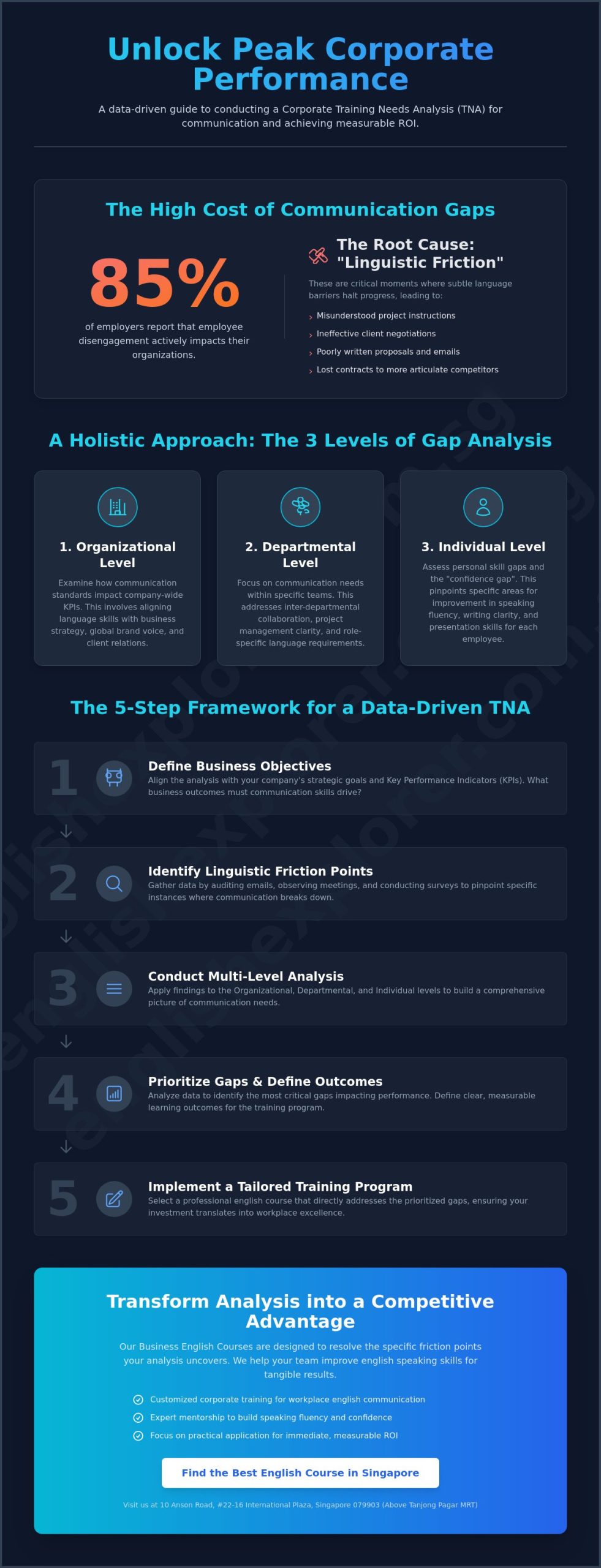
A 5-Step Framework for Conducting a Communication TNA
Transitioning from identifying friction points to implementing solutions requires a disciplined methodology. A successful corporate training needs analysis for communication follows a structured path that aligns linguistic development with your firm’s strategic vision. This isn’t a one-time HR task; it’s an ongoing commitment to professional excellence. By following this 5-step framework, you can ensure that every training dollar spent contributes to a more cohesive and productive workforce.
- Step 1: Define Desired Communication Outcomes. Begin by linking language goals to specific performance indicators. Instead of aiming for “better English,” target a reduction in client revision requests or a faster turnaround on internal reports.
- Step 2: Collect Data. Utilize surveys, one-on-one interviews, and direct observation to gather a comprehensive view of current communication habits and challenges.
- Step 3: Conduct a Linguistic Proficiency Audit. Evaluate both spoken and written abilities through situational roleplays and writing samples that mirror actual workplace tasks.
- Step 4: Identify and Prioritize Gaps. Determining which communication failures carry the highest business risk is the most critical part of a corporate training needs analysis for communication. Address these high-stakes areas first.
- Step 5: Design a Targeted Learning Path. Whether through private coaching or group sessions, ensure the curriculum is customized to the specific needs identified in your audit.
Data Collection Techniques for Communication
Objective data is the foundation of any effective audit. We recommend using 360-degree feedback to uncover blind spots in leadership communication that traditional surveys might miss. Reviewing anonymized email threads is another powerful technique to spot recurring tonal errors or grammatical inconsistencies that could damage your brand’s reputation. Finally, observing live meetings allows you to evaluate improve english speaking skills opportunities in real-time, focusing on how staff handle interruptions, technical explanations, and persuasion.
Prioritizing Training for Maximum ROI
Not all communication gaps are created equal. You must differentiate between “nice-to-have” conversational skills and business-critical communication that impacts your bottom line. Focus your initial efforts on high-impact roles, such as client-facing executives or management teams responsible for cross-border collaboration. Setting realistic timelines for linguistic improvement is equally essential; true mastery is a journey that requires consistent practice and expert guidance. If you are ready to move from analysis to action, you can book a consultation with our curriculum experts to design a training roadmap that delivers measurable results.
Transforming Analysis into Results with English Explorer
Once you’ve completed a thorough corporate training needs analysis for communication, the next step is selecting a partner capable of translating those insights into tangible results. English Explorer bridges the gap between identifying a need and achieving workplace excellence. By utilizing a world-class syllabus from Oxford University Press, we provide a structured learning environment that respects the time and ambition of working professionals. We don’t just teach English; we equip your team with the tools to navigate the global business stage with unshakeable confidence.
Every organization has unique friction points, which is why we specialize in customizing our business english course to match your specific TNA findings. Whether your audit revealed a need for better negotiation skills in sales or more precise technical reporting, our curriculum adapts to your operational reality. We offer flexible learning formats to suit your team’s schedule:
- Online Training: Interactive digital sessions designed for hybrid and remote teams.
- Private 1-on-1 Coaching: Personalized mentorship for executives and key personnel seeking mastery.
- Intensive Group Sessions: Focused workshops for departmental alignment and collaborative growth.
Success is measured through rigorous post-training assessments, ensuring that the linguistic growth you see is both permanent and impactful. This data-driven approach allows leadership to track progress and provide ongoing professional support where it is needed most. By closing the gaps identified in your corporate training needs analysis for communication, you ensure that every team member can contribute to a culture of high-performance and clarity.
Why Professional Tutors Matter
Effective communication training requires more than just a native speaker; it demands a mentor who understands the mechanics of language acquisition. Our tutors are CELTA-certified experts who combine academic rigor with practical business experience. This high level of expertise allows us to design a customized curriculum that ensures every hour of training is directly relevant to your industry. We act as a steady hand, guiding your staff through the complexities of a professional english course designed for the modern workplace. Our commitment to excellence ensures that learners at all levels feel supported as they transition toward global connectivity.
Next Steps for HR and L&D Leaders
Empowering your workforce begins with a single, decisive step toward global connectivity. Booking a consultation allows our team to help you refine your communication audit, ensuring your annual L&D strategy is built on a foundation of objective data. Integrating our proven methodology into your development plans creates a culture of continuous improvement and formal recognition. By providing high-quality adult english classes in Singapore, you aren’t just offering a course; you’re investing in the future leadership potential and workplace excellence of your entire organization. Let us help you turn your training investment into a measurable competitive advantage.
Empower Your Workforce for Global Success
Mastering your organization’s potential requires a shift from generic learning to targeted, data-driven precision. By implementing a structured corporate training needs analysis for communication, you’ll ensure that your investment translates into real-world fluency and executive presence. You’ve seen how identifying linguistic friction points and prioritizing high-impact roles can turn communication from a hurdle into a competitive advantage.
English Explorer stands ready to guide you through this transformation. Our CELTA-certified instructors utilize the world-class Oxford University Press syllabus to deliver a professional english course that yields measurable results. Whether you’re searching for an english course near me to improve english speaking skills or a comprehensive business english course, our methodology is designed for the high-stakes demands of 2026. Located right above Tanjong Pagar MRT at International Plaza, we provide the best english course experience for the english course singapore market.
Book a Corporate Consultation at English Explorer Today
The path to workplace excellence is built on clarity and confidence. Start your team’s journey toward global connectivity today and empower them to lead with authority in every interaction.
Frequently Asked Questions
How long does a thorough communication training needs analysis take?
A thorough corporate training needs analysis for communication typically takes between two and four weeks to complete. The exact duration depends on the size of your workforce and the depth of data collection methods used, such as one-on-one interviews or detailed email audits. This timeline ensures a meticulous review of linguistic friction points without disrupting daily operations. It allows your leadership team to develop a well-considered roadmap for professional growth.
What are the most common communication gaps found in Singaporean corporations?
The most frequent gaps include a lack of speaking fluency in high-stakes meetings and a reliance on localized jargon that hinders international clarity. Many employees struggle with the “confidence gap,” where they have technical expertise but cannot articulate ideas persuasively. Identifying these specific workplace english communication hurdles is essential for selecting the right training path. Addressing these issues ensures your team projects a high level of expertise to global partners.
Can a TNA help justify the budget for a professional English course?
A well-executed analysis provides the objective data necessary to justify your training investment to stakeholders. By linking communication gaps to specific business risks, such as lost contracts or low employee engagement, you transform a soft skill request into a strategic necessity. This evidence-based approach demonstrates how a professional english course will deliver a measurable return on investment. It moves the conversation from cost to value.
Should I focus on written or spoken English gaps first in my analysis?
You should prioritize the area that presents the highest risk to your current business objectives. If your team frequently interacts with global clients via video calls, you may need to improve english speaking skills as a priority. However, if your primary output involves complex proposals or reports, focusing on written clarity might be more urgent. A balanced corporate training needs analysis for communication will evaluate both to determine the most critical starting point.
How do I measure the ROI of communication training after the TNA?
ROI is measured by comparing post-training performance against the specific KPIs established during your initial audit. This might include tracking a reduction in communication related errors, improved client satisfaction scores, or faster internal project completion times. By using the baseline data from your analysis, you can clearly see the progress made through adult english classes. This quantitative approach builds trust in your long-term learning and development strategy.
Is it better to conduct the analysis internally or hire an external specialist?
Hiring an external specialist is often more effective because they provide an objective perspective and deep linguistic expertise that internal HR teams may lack. External mentors can identify subtle tonal or grammatical patterns that internal staff might overlook due to familiarity. Specialists also bring proven frameworks and assessment tools that accelerate the process. This ensures your business english course is built on a foundation of professional grade insights and academic rigor.
What tools can I use to automate the communication audit process?
You can utilize digital survey platforms and AI driven writing analysis tools to gather and process large amounts of data efficiently. Online proficiency tests provide a quick baseline for grammar and vocabulary levels across different departments. While these tools offer speed, they should be paired with human observation for a complete picture of interpersonal nuance. This combination of technology and expert mentorship ensures your training roadmap is both precise and human centered.