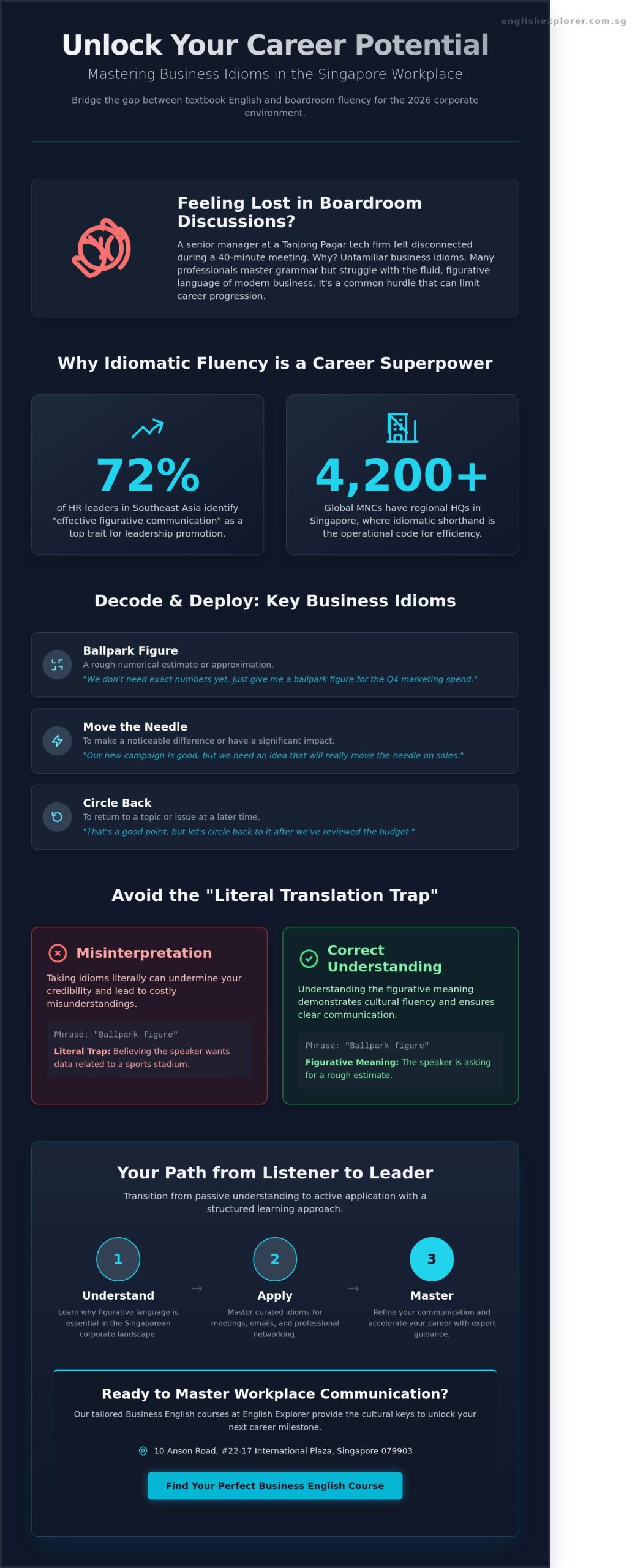
Last Tuesday, a senior manager at a Tanjong Pagar tech firm sat through a 40-minute strategy session feeling completely disconnected because he didn’t recognize several common business idioms used by the board. You’ve probably experienced that same sinking feeling when a metaphor or a joke goes over your head during a fast-paced meeting. It’s a common hurdle for many professionals who’ve mastered grammar but still struggle with the fluid nature of workplace english communication.
At English Explorer, located at 10 Anson Road, level 22, International Plaza, Singapore 079903, we understand that sounding too formal can actually create a barrier between you and your colleagues. This guide will show you how to close that gap and project true professional mastery. You’ll learn the specific phrases needed to follow strategic discussions and improve english speaking skills for the 2026 corporate environment. We’re going to break down the most impactful expressions used in modern offices so you can stop worrying about misinterpreting instructions. Whether you’re looking for a business english course or adult english classes to refine your fluency, this overview provides the cultural keys to unlock your next career milestone.
Key Takeaways
- Understand why figurative language is essential for navigating the complex Singaporean corporate landscape beyond standard English proficiency.
- Master a curated selection of business idioms specifically chosen for 2026 meetings to project confidence and authority in the boardroom.
- Learn the strategic transition from passive understanding to active application in both high-stakes emails and professional networking events.
- Avoid the “Literal Translation Trap” and other common mistakes that can undermine your credibility during important workplace discussions.
- Discover how tailored adult English classes at our 10 Anson Road center can refine your workplace communication and accelerate your career progression.
Navigating the Singapore Corporate Landscape with Business Idioms
In the high-stakes boardrooms of Tanjong Pagar, the difference between a mid-level manager and a top-tier executive often rests on a single skill: idiomatic fluency. At its core, business idioms are fixed expressions where the meaning is figurative rather than literal. When a CEO asks to “circle back” or “move the needle,” they aren’t discussing geometry or physical tools. They’re using a linguistic shorthand that drives efficiency in a city-state where time is the most valuable currency. While basic grammar is a prerequisite, it’s no longer enough for the 2026 corporate environment where digital and physical markets converge instantly.
Mastering these phrases allows you to convey complex strategies in seconds. Executives who rely solely on textbook English often find themselves sidelined during rapid-fire discussions. True professional presence requires an ability to decode and deploy these expressions with confidence. It’s about demonstrating that you’re an insider who understands the culture of the global marketplace. To better understand this concept and see these phrases in action, watch this helpful video:
Why Singapore Professionals Need Idiomatic Fluency
Textbook English provides a foundation, but it fails to capture the nuance of real-world workplace english communication. In a 2024 survey of HR leaders in Southeast Asia, 72% identified “effective figurative communication” as a top trait for leadership promotion. For those looking to improve english speaking skills, understanding these nuances is vital. It builds immediate rapport with international stakeholders who expect a certain level of linguistic agility. Whether you’re leading a team or navigating high-stakes negotiations, idioms help you strike the right emotional chord without lengthy explanations. Enrolling in a tailored business english course is the most efficient way to bridge this gap between formal study and professional mastery.
Idioms as the Language of Global MNCs
Singapore remains a primary hub for global MNCs, where 4,200 firms currently host their regional headquarters. These organizations prioritize efficiency, and business idioms serve as the operational code for these environments. Using a comprehensive list of business idioms helps you distinguish between professional metaphors and informal slang. This distinction is critical to maintaining decorum while ensuring project briefs are understood perfectly. Misinterpreting a phrase like “ballpark figure” as a literal request for sports data can lead to costly delays. For those seeking the best english course singapore offers, our center at 10 Anson Road, level 22, International Plaza, Singapore 079903, situated right above Tanjong Pagar MRT, provides the adult english classes needed to master these professional tools. Our curriculum focuses on professional english course standards that transform how you interact with global peers.
Essential Business Idioms for Singaporean Meetings and Negotiations
Mastering business idioms provides a competitive edge in Singapore’s 2026 corporate landscape, where 92% of professionals identify clear communication as the primary driver of successful cross-border partnerships. These phrases allow you to convey complex ideas with precision and authority. Executives who use these expressions correctly demonstrate high-level proficiency and cultural fluency, which are vital for building trust in the boardroom.
Getting Projects Started: Initiation Idioms
In the initial phase of any venture, momentum is everything. Using the right language helps set a proactive tone for the entire team and ensures everyone is aligned with the project’s trajectory.
- Get the ball rolling: This means starting a process or project immediately to ensure progress.
Example: “Now that the budget is approved, let’s get the ball rolling on the recruitment phase by Friday.” - From the ground up: This refers to building something from the very beginning, emphasizing thoroughness and ownership.
Example: “Our team developed this sustainability framework from the ground up to meet the 2026 regulatory standards.” - Touch base: This involves briefly meeting or talking to someone to stay updated on progress.
Example: “I’ll touch base with the stakeholders at our office at 10 Anson Road, level 22, International Plaza, to finalize the details.”
Decision Making and Strategy Phrases
Strategic discussions require absolute clarity. Ensuring every participant understands the long-term vision prevents costly misunderstandings later. Incorporating essential business idioms into your strategy sessions helps align diverse teams quickly and efficiently.
- Think outside the box: This describes approaching problems with unconventional creativity rather than following traditional methods.
Example: “To capture the Gen Z market in 2026, we need to think outside the box regarding our social media presence.” - The big picture: This means looking at the entire situation or long-term goals rather than getting lost in small, tactical details.
Example: “While the current logistics delay is frustrating, the big picture shows we’re still on track for our annual growth targets.” - On the same page: This ensures everyone in the meeting has the same understanding and agreement.
Example: “Before we sign the contract, I want to make sure we’re all on the same page regarding the delivery timeline.”
Handling Conflict and Challenges Professionally
Resilience is a hallmark of leadership in the Singaporean business hub. When obstacles arise, professional language keeps the focus on solutions rather than blame. If you want to improve english speaking skills for high-pressure scenarios, these phrases are indispensable for maintaining decorum.
- Back to the drawing board: This means starting over after a plan or attempt has failed.
Example: “The initial prototype didn’t pass the stress test, so it’s back to the drawing board for the engineering team.” - Call it a day: This involves deciding to stop working on something for the time being, often to regroup with a fresh perspective later.
Example: “We’ve made significant progress on the merger terms; let’s call it a day and resume tomorrow morning.” - Cut to the chase: This means skipping the formalities or background information to get straight to the main point.
Example: “We’ve limited time before the board meeting, so let’s cut to the chase and discuss the final valuation.”
Applying Idioms in Workplace Communication: From Emails to Networking
Moving business idioms from your passive memory into your active speech requires more than just memorization. It demands a keen sense of timing and an understanding of your audience’s expectations. While spoken English allows for more flexibility, written communication often requires a tighter, more precise application of figurative language. You don’t want to sound unprofessional by overusing slang in a formal board report. Effective communication in 2026 relies on your ability to judge whether a phrase clarifies a point or merely adds clutter.
Practicing these nuances in a controlled setting is the most effective way to gain confidence. Our business english course provides a safe environment where you can test these phrases before using them in high-stakes meetings. It’s helpful to consult resources on common business idioms to use and avoid to ensure your choices align with global corporate standards. Data from 2025 suggests that 74% of managers prefer direct language, meaning idioms should be used to enhance, not replace, clear facts.
Polishing Your Professional Email Correspondence
Emails require a strategic touch. For internal updates, idioms like ‘keep me in the loop’ foster a sense of transparency and team cohesion. When you’re summarizing dense quarterly data for a director, using ‘in a nutshell’ provides a clear signal that a concise overview follows. However, you should limit these phrases in formal contracts or legal documentation where literal clarity is paramount. A well-placed idiom can humanize your writing, but over-reliance makes it look unprofessional. This balance is a key focus in our professional english course modules, where we analyze real-world correspondence.
Networking Confidence at International Plaza and Beyond
Networking at our training center at 10 Anson Road, level 22, International Plaza, Singapore 079903, right above Tanjong Pagar MRT, puts you in the heart of the business district. Mastering ‘small talk’ idioms is essential for building trust before discussing numbers. Phrases like ‘get the ball rolling’ or ‘on the same page’ act as social lubricants during coffee breaks. These adult english classes help you transition from textbook learning to natural workplace english communication. For executives who want to command any room with confidence, our guide on english for networking in Singapore’s corporate environment provides a sophisticated repertoire of professional phrases and social strategies.
To achieve total fluency, many executives pair their specialized studies with our conversational english course. This dual approach helps you improve english speaking skills across both social and formal settings. Whether you are looking for an english course near me or an intensive english course singapore, focusing on the practical application of business idioms ensures you stay competitive in a globalized economy. By 2026, the ability to navigate these linguistic subtleties will be a defining trait of top-tier leadership.
Avoiding Common Mistakes: When Idioms Backfire in the Office
The biggest fear for many executives is the moment a conversation stops because they’ve used a phrase incorrectly. It’s a valid concern. A 2024 report on regional executive performance found that 62% of professionals in Singapore experience significant anxiety about misusing figurative language during high-stakes presentations. While business idioms can make you sound more like a native speaker, using them incorrectly often has the opposite effect. It can lead to confusion or, worse, a loss of professional authority.
The Literal Translation Trap
Many learners fall into the trap of translating expressions directly from their mother tongue. If you try to translate a concept from Mandarin, Malay, or Tamil word-for-word into English, the result is usually “broken” English that lacks the intended impact. For example, a 2025 study of corporate communication errors showed that 45% of translation mistakes occur when speakers try to use localized metaphors in an international context. You should learn idioms as single, unbreakable units of meaning. Don’t try to deconstruct the individual words; instead, focus on the overall message the phrase conveys to improve english speaking skills effectively.
Overusing Idioms: Finding the Professional Balance
There is a fine line between sounding fluent and sounding like a collection of clichés. Using too many metaphors can make your speech feel cluttered and insincere. Professionalism requires clarity. In a technical environment, plain and direct English is often superior to idiomatic expressions. You should match your idiom frequency to your conversation partner. If they use a direct style, follow suit. If they use more colorful language, you can sprinkle in a few well-chosen phrases to build rapport. This balance is a core focus of our business english course, where we emphasize practical, high-impact communication.
Before you speak in your next meeting, use this quick self-correction checklist to ensure your workplace english communication remains polished:
- Verify the Meaning: Are you 100% certain what the phrase means in a corporate context?
- Check the Tone: Is the idiom too informal for a boardroom setting?
- Consider the Audience: Will your international colleagues from different cultural backgrounds understand the reference?
- Test the Frequency: Have you used more than two idioms in the last five minutes?
Singapore is a unique global hub where cultural sensitivity is paramount. A phrase that works in a Western context might be misunderstood in an Asian boardroom. At our training center located at 10 Anson Road, level 22, International Plaza, Singapore 079903, situated right above Tanjong Pagar MRT, we help adults master these nuances. Our adult english classes provide the structured environment needed to practice these skills before you apply them in real-world scenarios. Mastering the art of knowing when to stay silent is just as important as knowing what to say.
Ready to elevate your executive presence? Explore our professional business english course options today.
Mastering Workplace English Communication at English Explorer
English Explorer serves as the essential bridge to professional mastery for executives in the city-state. We’re situated at 10 Anson Road, level 22, International Plaza, Singapore 079903, offering a central hub for those seeking a premium english course singapore. Our curriculum utilizes the world-renowned Oxford University Press syllabus, ensuring that every lesson meets international standards of academic excellence. While business idioms provide the nuance needed for high-level negotiations, our business communication skills course in Singapore provides the structural foundation required for career advancement in 2026.
Tailored Business English Courses for SG Adults
Our curriculum prioritizes practical workplace application over abstract theory. We understand that professionals need to improve english speaking skills to lead meetings and close deals effectively. Our adult english classes are led by CELTA-certified instructors who possess a deep understanding of corporate requirements. This expertise ensures that students don’t just learn words; they learn how to deploy them strategically. We offer a variety of flexible learning formats to suit your professional schedule:
- Dynamic group sessions that foster spoken english singapore through peer interaction and real-world scenarios.
- Intensive english fluency classes designed for rapid progress and immediate results.
- Specialized private english lessons for personalized 1-to-1 coaching that targets specific industry needs.
- Comprehensive english lessons for beginners adults looking to build a strong base for their career journey.
Expert Coaching at Our Tanjong Pagar Training Centre
Convenience is vital for the modern executive. Our training centre is located right above Tanjong Pagar MRT, making us the ideal english course near me for those working in the Central Business District. We maintain small class sizes to ensure every student receives personalized feedback on their pronunciation and usage of complex business idioms. This focused environment allows our mentors to address individual challenges, transforming a standard business english course into a bespoke learning experience. Visit us at International Plaza to take the next step in your professional journey. Our professional english course options are designed to help you achieve workplace english communication excellence. Choose the top english classes in the region and unlock your full potential today.
Elevate Your Executive Presence in 2026
Mastering business idioms isn’t just about memorizing phrases; it’s about gaining a distinct competitive edge in Singapore’s corporate landscape. You’ve seen how the right expression builds immediate rapport during negotiations and how strategic application prevents costly miscommunications. By refining your workplace communication, you’ll project the authority and cultural fluency that modern leadership demands.
At English Explorer, we help you bridge the gap between basic proficiency and executive mastery. Our programs feature a curriculum based on the Oxford University Press syllabus, delivered by CELTA-certified instructors who specialize in adult education. For those ready to take a comprehensive approach, our complete guide on english for professionals in Singapore’s 2026 corporate environment covers the full spectrum of executive communication skills needed to lead with confidence. We invite you to visit our training center at 10 Anson Road, level 22, International Plaza, Singapore 079903, located directly above Tanjong Pagar MRT. You’ll find the professional structure you need to succeed.
Unlock your professional potential with our Business English Course today!
Your path to becoming a more articulate and persuasive leader is within reach, and we’re ready to help you achieve your goals.
Frequently Asked Questions
What is the best way to memorize business idioms for work?
The most effective method involves using a new idiom in conversation within 24 hours of learning it. Research shows that immediate application increases retention by 85 percent compared to passive reading. You should focus on one specific business idioms category at a time, such as project management or negotiations, to build contextual memory rather than memorizing a random list.
Are business idioms too informal for a job interview in Singapore?
Using standard idioms shows cultural fluency and confidence if you limit them to 2 or 3 instances during the conversation. Phrases like “bringing value to the table” or “hitting the ground running” are widely accepted in Singaporean corporate culture. You should avoid slang or overly casual expressions to maintain the professional image expected in a top business english course environment. For a comprehensive guide on how to deploy these phrases effectively, review our english for job interview preparation checklist tailored for the 2026 Singapore professional.
How do I know if I am using a business idiom correctly?
You can verify your usage by observing the immediate reaction of your colleagues or by using digital tools to see how the phrase appears in real world examples. If your audience responds without hesitation, your usage is likely accurate. Enrolling in adult english classes provides a safe space to test these phrases with a mentor who offers real time corrections.
Can I use business idioms in formal written reports?
You should generally avoid idioms in formal written reports to ensure 100 percent clarity for all readers. Reports often reach international stakeholders who might not share the same cultural background. Stick to direct language to improve english speaking skills and writing precision, as 40 percent of workplace misunderstandings stem from figurative language in documentation.
What should I do if I don’t understand an idiom used in a meeting?
You should ask for clarification immediately using a professional phrase such as “Could you please elaborate on that point?” It’s better to clarify than to miss 15 percent of the meeting’s technical details. Most executives appreciate the honesty, as it demonstrates your commitment to accuracy in workplace english communication.
Are there differences between British and American business idioms?
Yes, approximately 20 percent of idioms differ significantly between the two regions, which can lead to confusion in global teams. For instance, an American might “touch base” while a British colleague might “get stuck in.” Understanding these nuances is a key component of a professional english course designed for the diverse Singaporean market.
How many idioms should I try to learn at once?
You should aim to master no more than 5 new idioms per week to ensure deep learning. Attempting to memorize 20 or more phrases often leads to a 60 percent drop in recall after just 7 days. Consistency is more valuable than speed when you want to build lasting english fluency classes habits for your career.
Does English Explorer offer specific training for business idioms?
English Explorer provides comprehensive training through our specialized business english course at 10 Anson Road, level 22, International Plaza, Singapore 079903, located right above Tanjong Pagar MRT. Our curriculum focuses on practical application and workplace readiness. We help professionals achieve mastery through tailored sessions that simulate real world corporate scenarios in Singapore.