What if the only thing standing between your current role and a senior leadership position isn’t your technical expertise, but the way you articulate it in the boardroom? Many professionals in Singapore feel a sudden surge of anxiety the moment a presentation begins. You might worry about mispronouncing technical terms or struggle to find the right words to link complex ideas. It’s common to feel that your professional authority is undermined by repetitive phrasing or a lack of fluency during high-stakes Q&A sessions. Mastering english for business presentations is about more than just vocabulary; it’s about projecting confidence through structured, persuasive communication.
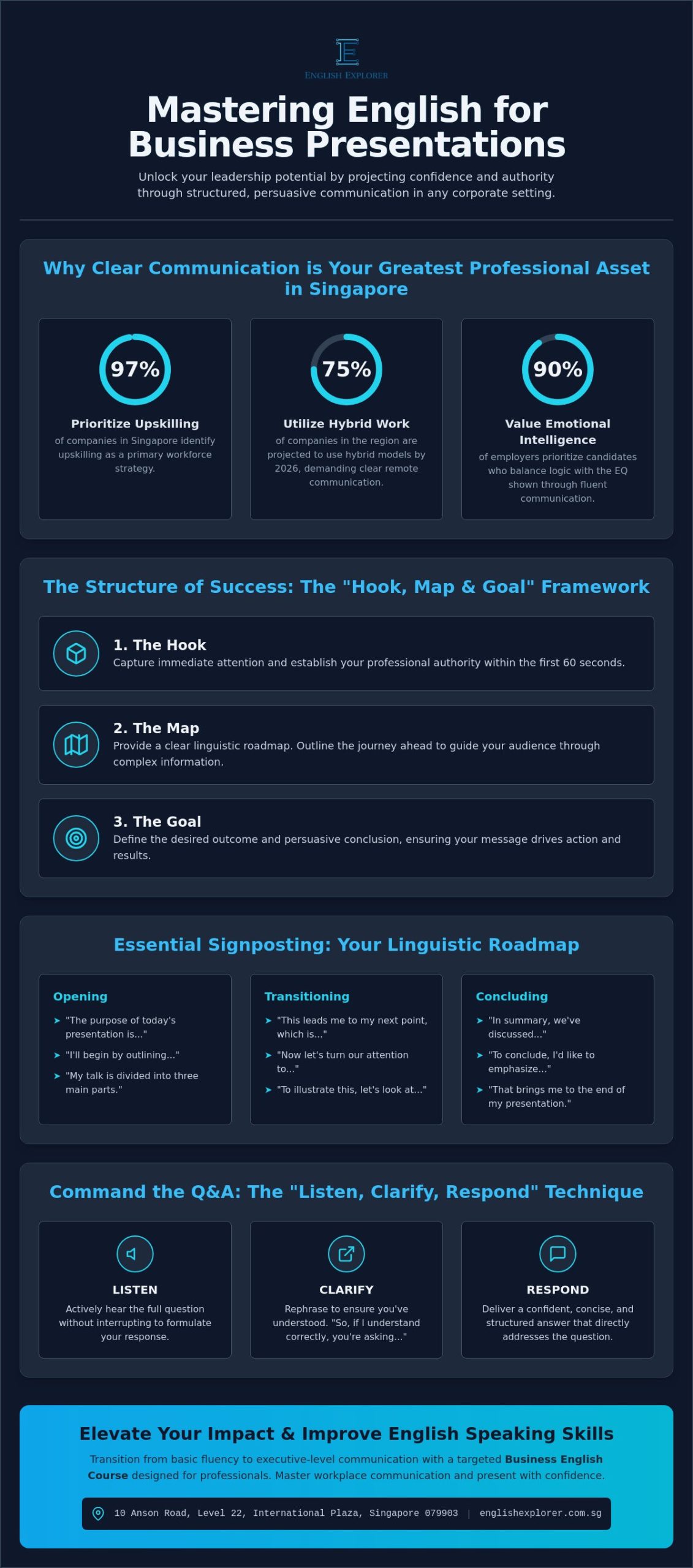
With 97% of companies in Singapore prioritizing upskilling as a primary workforce strategy, your ability to communicate clearly is your greatest professional asset. This guide provides the essential signposting phrases and delivery techniques needed to present with authority in any corporate setting. You’ll learn how to move beyond basic slides to deliver a narrative that secures deals and impresses stakeholders. We’ll explore how a targeted business english course at 10 Anson Road, level 22, International Plaza, helps you improve english speaking skills, ensuring you lead every meeting with natural fluency and the steady hand of a seasoned leader.
Key Takeaways
- Understand why structured signposting is the secret to guiding your audience through complex data with clarity and professional authority.
- Master the precise vocabulary and nuanced adverbs required to describe market trends and financial visuals with corporate-level accuracy.
- Learn the “Listen, Clarify, Respond” technique to maintain composure and command the room during challenging Q&A sessions.
- Discover the “Hook, Map, and Goal” framework to structure your english for business presentations for maximum impact from the very first slide.
- Explore how expert-led training using the Oxford University Press syllabus helps you transition from basic fluency to executive-level communication.
Why Mastering English for Business Presentations is Critical in Singapore’s Corporate Landscape
In the heart of Singapore’s Central Business District, the ability to command a room isn’t just a soft skill; it’s a prerequisite for executive success. As of 2026, with 75% of companies in the region utilizing hybrid work models, the clarity of your english for business presentations determines how effectively you bridge the gap between digital slides and human connection. Professionals who excel don’t just “survive” their speaking slots. They lead discussions, influence stakeholders, and transform technical data into persuasive narratives that drive results.
The role of English as the lingua franca in Singapore’s multinational hubs means that your audience often comprises diverse linguistic backgrounds. This high-pressure environment demands more than just basic fluency. It requires a psychological shift from being a passive presenter to an authoritative leader. When you present with precision, you signal to senior management that you’re ready for greater responsibilities and leadership roles.
To better understand how to engage an audience from the very beginning of a session, watch this helpful video:
The High Stakes of Workplace English Communication
Clear communication is the lifeblood of cross-border collaboration. In a city where 90% of employers prioritize candidates who balance logic with emotional intelligence, linguistic pitfalls can be costly. Mispronouncing a key financial term or using overly informal phrasing during a board meeting can subtly undermine your credibility. A professional english course helps you identify these blind spots. By refining your workplace english communication, you ensure that your message remains the focus, rather than your delivery errors. This is especially vital for professionals who interact daily with global partners across the Asia-Pacific region.
Beyond Vocabulary: The Impact of Delivery and Tone
Mastering the core principles of public speaking involves much more than just memorizing a script. Your vocal variety, pauses, and body language complement your linguistic skills to create a sense of authority. It’s essential to adapt your register depending on whether you’re addressing senior management or a peer-level technical team. Using a high-stakes, performance-driven tone with executives requires specific signposting and a confident cadence. You can find many natural opportunities to improve english speaking skills during daily interactions, but formalizing that practice ensures you maintain a professional standard that aligns with Singapore’s competitive corporate landscape.
The Structure of Success: Essential Signposting for Every Presentation Stage
A successful presentation functions like a well-marked linguistic roadmap. You aren’t just reading slides; you’re acting as a guide, leading your audience toward a specific persuasive conclusion. To achieve this, we utilize the “Hook, Map, and Goal” framework. This structure ensures your listeners remain engaged from the very first sentence. Your hook captures immediate attention, your map outlines the journey ahead, and your goal defines the desired outcome. Mastering english for business presentations requires this level of structural discipline to ensure your message isn’t lost in the complexities of corporate jargon.
The Opening: Establishing Authority in the First 60 Seconds
Your first 60 seconds establish your professional authority. Using the Oxford University Press syllabus method, we encourage students to state their purpose with surgical precision. Instead of vague openings, use standard phrases like “The purpose of today’s presentation is to…” or “I’m here today to report on…”. It’s also the critical time to set expectations for the room. Clearly state whether you prefer questions throughout the session or a dedicated Q&A at the end. This transparency reduces audience anxiety and positions you as a leader who is in total control of the environment.
Signposting: The Secret to Professional Workplace English
Signposting phrases act as the glue between your ideas. They prevent your audience from getting lost when you transition between complex data sets or different sub-topics. Phrases such as “Turning now to our quarterly results” or “This leads me to my next point” provide the necessary cues for listeners to follow your logic. While many professionals might consider a Business English presentations course to grasp these basics, the real skill lies in using them naturally without sounding repetitive.
You can build a persuasive case by linking arguments logically with phrases like “In light of these findings” or “Given this context”. This level of linguistic sophistication is what separates a standard update from a high-impact executive briefing. Effective english for business presentations involves more than just a list of words; it’s about the rhythm of delivery and the logical flow of information.
Finally, your conclusion should do more than just summarize. It must drive action. There is a significant difference between saying “In conclusion, we saw growth” and “Based on this growth, I recommend we approve the new budget”. End with impact by clearly stating the next steps. If you want to refine these techniques in a professional setting, consider joining a business english course to practice with expert guidance and peer feedback.
Presenting Data and Visuals: Describing Trends with Professional Precision
Data serves as the backbone of any corporate argument, but numbers alone rarely persuade a board of directors. To excel in english for business presentations, you must move beyond simply reading figures from a slide. You need to narrate the story those numbers tell. This requires a sophisticated grasp of trend-specific vocabulary and the ability to add nuance through careful adverbial choices. Whether you’re reporting quarterly growth or analyzing a market dip, your linguistic precision directly reflects your professional competence.
Effective data description relies on a mix of dynamic verbs and descriptive nouns. Using varied language prevents your delivery from sounding repetitive and keeps your audience engaged. Consider these essential pairings for your next briefing:
- Upward Trends: Use verbs like “soared,” “climbed,” or “surged.” For nouns, refer to a “significant increase” or a “sharp rise.”
- Downward Trends: Opt for “plummeted,” “declined,” or “slumped.” Nouns include a “gradual dip” or a “marked reduction.”
- Stability and Fluctuation: Describe periods of no change as “leveling off” or “remaining steady.” If the data is inconsistent, use “fluctuated” to describe the movement.
Adverbs allow you to quantify change without cluttering your slides with extra text. Saying a profit “rose significantly” conveys a vastly different message than saying it “rose slightly.” These small distinctions help your audience understand the scale and urgency of the information you’re presenting. Your ability to interpret the logic behind the numbers is just as important as the numbers themselves, as it demonstrates the strategic thinking expected in executive roles.
Visual Aid Vocabulary for Modern Professionals
Introducing your visuals with confidence is the first step toward audience engagement. Use phrases like “If you look at this bar chart,” or “This infographic illustrates the correlation between…” to draw the eye to specific data points. Avoid “Death by PowerPoint” by keeping your verbal explanations lean. Your role is to simplify complex data sets for diverse audiences, ensuring that even non-technical stakeholders can grasp the core message. Don’t just state that sales dropped; explain the market factors or consumer shifts that drove that result.
Describing Business Performance and Projections
Accuracy in tenses is critical when shifting between historical performance and future forecasts. Use the past simple for completed periods and the “is projected to” structures for upcoming targets. When discussing challenges or plateaus, maintain a professional tone by using neutral language like “we encountered a period of stagnation” rather than emotional phrasing. For those looking to master these nuances, our Business English course provides intensive training on data description. Our sessions help you bridge the gap between technical data and executive-level storytelling through guided practice and expert critique.
Handling the Q&A Session: Strategies for Responding with Confidence
The final slide is often followed by a heavy silence or a sudden barrage of questions. This moment is the ultimate test of your english for business presentations. While your slides are scripted, the Q&A session is spontaneous. It requires you to think on your feet while maintaining a professional register. To manage this effectively, we teach the “Listen, Clarify, Respond” technique. This method ensures you don’t rush into an answer that might be incomplete or off-target. It gives you the mental space to construct a response that reinforces your authority.
First, listen without interrupting. It shows respect and gives you time to process the query. Second, clarify the question by paraphrasing it back to the speaker. This prevents misunderstandings and demonstrates active listening. Finally, respond with a concise, evidence-based answer. If you don’t have the data immediately available, don’t panic. Use phrases like, “That’s a valid point; let me check the specific figures and get back to you by the end of the day.” This buys you time while preserving your credibility in a high-pressure environment.
Clarification and Active Listening Skills
In a formal Singaporean boardroom, clarity is paramount. Use standard English phrases such as “If I understand you correctly, you’re asking about…” or “Could you please elaborate on what you mean by…”. These structures allow you to ask for more detail without sounding confrontational. When a single participant asks multiple questions, address them one by one. You might say, “You’ve raised three points here. Let’s start with the first one regarding the budget.” This keeps the discussion organized and ensures every concern is met with precision.
Managing Challenging Interactions
Not every question will be easy. Some might be off-topic or even slightly confrontational. Handling these requires diplomatic disagreement. Instead of saying “You’re wrong,” try “I see your point, but our data suggests a different outcome.” If the conversation drifts, redirect it firmly: “That’s an interesting topic for another time, but for now, let’s stay focused on the current agenda.” Mastering these nuances is a core part of a business communication skills course. It’s about maintaining control of the room’s energy while respecting the audience’s input.
Close your Q&A by summarizing the key takeaway one last time. This ensures the presentation ends on your terms, not just with a random question. If you want to build this level of confidence and improve english speaking skills, enroll in the best english course in Singapore at our center located at 10 Anson Road, level 22, International Plaza, Singapore 079903. We help you turn every Q&A session into an opportunity for professional growth and leadership.
Elevate Your Impact with English Explorer’s Business English Course
Choosing the right environment for your professional development is just as critical as the curriculum itself. At English Explorer, we act as a steady mentor, bridging the gap between your current communication level and your future leadership aspirations. Our CELTA-certified instructors bring a depth of expertise that goes beyond simple grammar. They understand the high-stakes nature of the Singaporean boardroom. By utilizing the world-renowned Oxford University Press syllabus, we ensure that every lesson provides the linguistic rigor and practical application you need to master english for business presentations.
Our learning formats are designed to fit the demanding schedules of modern professionals. Whether you choose the personalized focus of private English lessons or the dynamic interaction of our adult english classes, you’ll find a supportive yet disciplined atmosphere. We’re conveniently located at 10 Anson Road, level 22, International Plaza, Singapore 079903, right above Tanjong Pagar MRT. This central location makes it easy to transition from your office to a professional learning space dedicated to your growth.
Customized Training for Corporate Success
We recognize that communication needs vary across different sectors. Our instructors tailor the curriculum to meet the specific demands of industries such as Finance, Technology, and Healthcare. This ensures that the vocabulary and scenarios you practice are directly relevant to your daily workplace challenges. Many organizations find that investing in corporate english training is the most effective way to improve team-wide presentation standards. By establishing a unified linguistic roadmap, your team can deliver a consistent message of excellence to global clients and stakeholders.
Start Your Journey to Presentation Mastery
When you join our adult english classes, you’re not just a student; you’re an active participant in a transformative journey. We begin with a thorough placement test at our International Plaza centre to identify your specific strengths and areas for improvement. This data-driven approach allows us to place you in the best english course for your current level, ensuring you see measurable progress in your workplace english communication.
Don’t let the fear of mispronunciation or a lack of fluency hold you back from the career you deserve. If you’re searching for a business english course or a professional english course that delivers real-world results, we’re here to guide you. Book your consultation today and take the first step toward commanding every room with authority. Your path to global connectivity and professional excellence starts right here in the heart of Tanjong Pagar.
Take Command of Your Professional Narrative
Elevating your impact in the boardroom requires a blend of structural precision and linguistic confidence. By implementing the signposting techniques and data narration strategies we explored, you transform every slide deck into a powerful tool for influence. Developing your english for business presentations is the most direct path to securing promotions and closing high-value deals in Singapore’s competitive landscape. It’s about moving beyond basic communication to project the authority of a true industry leader.
Our CELTA-certified instructors utilize the Oxford University Press syllabus to guide you through this professional transformation. We invite you to visit our center, conveniently located at International Plaza, Tanjong Pagar, to begin your journey toward executive-level fluency. The ability to articulate complex ideas with clarity is your greatest career asset; don’t leave your next big opportunity to chance.
Master your next presentation—enroll in our Business English course today!
Your future as a persuasive and authoritative speaker is within reach. We look forward to supporting your growth as you find your new path to global connectivity and professional excellence.
Frequently Asked Questions
How can I improve my English for business presentations quickly?
The most effective way to see rapid progress is to enroll in a structured business english course that focuses on practical application rather than just theory. Intensive practice with CELTA-certified instructors allows you to receive immediate feedback on your delivery and linguistic structures. By focusing on english for business presentations, you can master the specific signposting and transitions needed to sound professional in a matter of weeks.
What are the most common signposting phrases used in professional presentations?
Effective presenters use phrases like “Moving on to my next point,” “To illustrate this further,” and “Let’s turn our attention to the data.” These expressions act as a roadmap, helping your audience follow your logic without effort. Using these tools is a core component of workplace english communication, as they ensure your message remains clear even when discussing complex or technical corporate topics.
Should I memorize my entire presentation script to sound more fluent?
Memorizing an entire script is generally discouraged because it often leads to a robotic delivery and increased panic if you lose your place. It’s much better to memorize your opening, your closing, and your key transitions. This approach allows you to improve english speaking skills by speaking more naturally from bullet points, which projects a sense of authentic authority and expertise to your audience.
How do I handle my nervousness when speaking English in front of an audience?
Nervousness often stems from a fear of the unknown, so thorough preparation is your best defense. Practice your “Hook, Map, and Goal” framework until it becomes second nature. During english fluency classes, we teach students to use strategic pauses and controlled breathing to manage adrenaline. Remember that a professional audience is interested in your insights, not just your perfect grammar; focus on the value you’re providing.
What is the best way to describe charts and trends in a business meeting?
Use precise verbs and adverbs to narrate the story behind the data. Instead of saying a number “went up,” use professional terms like “surged significantly” or “increased steadily.” This level of precision is exactly what you’ll practice in a professional english course. It’s essential to explain the “why” behind the numbers, as this demonstrates the high-level critical thinking that Singaporean employers value in 2026.
Can private English lessons help me prepare for a specific upcoming presentation?
Yes, private english lessons are the ideal format for high-stakes preparation. You can bring your actual slide deck and script to the session, allowing your instructor to act as a mentor. They’ll help you refine your pronunciation of technical terms and role-play potential Q&A scenarios. This customized approach ensures you’re fully prepared to improve english speaking skills for your specific corporate context.
How does the Business English course at English Explorer differ from general conversation classes?
While a conversational english course builds general social fluency, our business-focused program targets executive-level competencies. We use the Oxford University Press syllabus to cover specialized topics like negotiation, data description, and formal briefings. The goal is to move beyond basic survival English toward achieving professional-grade authority in a multinational corporate environment, specifically tailored for the ambitions of working adults.
Is the International Plaza campus easily accessible for after-work classes?
Our center is perfectly situated for professionals looking for an english course near me in the CBD. We are located at 10 Anson Road, level 22, International Plaza, Singapore 079903, directly above Tanjong Pagar MRT. This prime location allows you to attend adult english classes immediately after work without a long commute, making it easier to stay consistent with your professional development goals.