
Did you know that by the end of 2026, research suggests 20% of organizations will use AI to automate more than 50% of middle management responsibilities? As the corporate world evolves, your ability to articulate complex ideas and lead discussions with precision remains your greatest professional asset. Many professionals struggle with feeling “stuck” for words when interrupted or worry about sounding too blunt when disagreeing in multicultural environments. If you’ve ever felt your message was lost because you lacked the right business english vocabulary for meetings, you aren’t alone.
We’re here to help you bridge the gap between your current skills and your future aspirations. This guide provides the strategic communication tools you need to master workplace english communication and sound like a native speaker. Whether you’re searching for an english course near me or a comprehensive professional english course, understanding these nuances is key. You’ll learn how to keep meetings on track, manage conflict gracefully, and project an image of excellence.
At our training center located at 10 Anson Road, level 22, International Plaza, Singapore 079903, right above Tanjong Pagar MRT, we specialize in adult english classes that drive real results. This article previews the proven methodology we use to improve english speaking skills for global connectivity. Let’s explore the essential phrases and strategic tools that will define your success in the 2026 corporate landscape.
Quick answer
Effective business English for meetings comes down to clear phrases for opening, agreeing and disagreeing, clarifying, and summarising. Practising these out loud with trainer feedback builds fluency far faster than memorising word lists.
| Meeting moment | Useful phrase type | Example |
|---|---|---|
| Opening | Set the agenda | “Let’s start by looking at…” |
| Agreeing / disagreeing | Diplomatic stance | “I see your point, however…” |
| Clarifying | Check understanding | “Could you elaborate on…?” |
| Summarising | Confirm next steps | “To recap, we’ll…” |
Key Takeaways
- Establish authority from the start by learning why specialized terminology is the foundation of professional presence in the Singapore corporate landscape.
- Gain the exact linguistic tools needed to launch a meeting with clarity and keep the agenda moving forward with absolute confidence.
- Navigate complex professional interactions using the Diplomacy Scale to disagree politely while maintaining strong workplace relationships.
- Identify essential 2026 jargon and virtual communication techniques that ensure your message remains clear and impactful across digital platforms.
- Learn how mastering a strategic business english vocabulary for meetings acts as a transformative tool for career advancement and leadership.
Mastering Business English Vocabulary for Meetings in Singapore
In the high-velocity environment of the Singapore CBD, your professional authority is directly tied to your linguistic precision. It isn’t just about being understood; it’s about commanding the room. When you step into a boardroom at International Plaza, your business english vocabulary for meetings serves as the foundation of your executive presence. It allows you to navigate complex discussions without hesitation. Our training center, located at 10 Anson Road, level 22, International Plaza, Singapore 079903, right above Tanjong Pagar MRT, sees firsthand how the right words empower professionals to lead.
To truly understand what is a meeting in a professional sense, one must view it as a strategic tool for alignment and progress. Relying on everyday English often leaves professionals feeling “stuck” when the conversation turns technical or high-stakes. Transitioning to a structured business english course helps you replace vague terms with impactful alternatives that resonate with global stakeholders. This shift marks the evolution from basic fluency to specialized communication that drives business results.
To better understand how to refine your digital communication skills alongside your in-person presence, watch this helpful video:
The High-Stakes Nature of Corporate Communication
Clarity always beats complexity in multicultural meeting rooms. While local nuances have their place in social settings, standard professional English ensures your message isn’t lost in translation when dealing with international partners. Developing strong workplace english communication skills helps you strip away ambiguity. This shift builds the verbal confidence needed to handle interruptions or high-pressure questions with grace. It transforms your role from a silent observer to an active, respected contributor. Precision in language reduces the risk of costly misunderstandings in fast-paced industries like finance or technology, where mastering specialized terminology through platforms like Cryptora Institute can provide a competitive edge.
Vocabulary as a Tool for Leadership
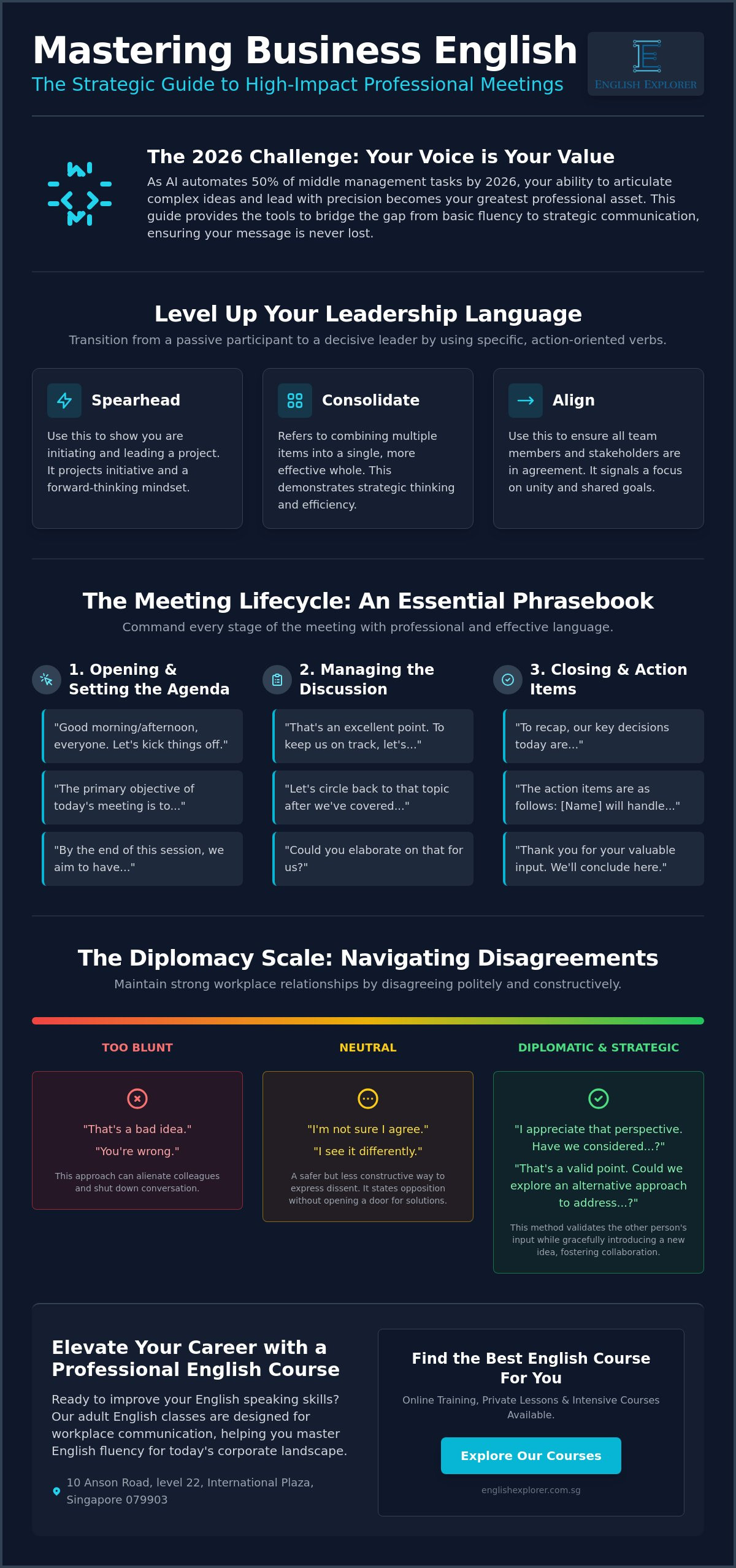
Leadership is often defined by the ability to facilitate, not just talk. Using specific, action-oriented verbs like “spearhead,” “consolidate,” or “align” projects a sense of competence and decisiveness. In a competitive market, these linguistic choices help you “level up” your professional persona. Our adult english classes focus on these strategic phrasings; you’ll learn how to guide a discussion toward a conclusion rather than just participating in the noise. This mastery allows you to frame challenges as opportunities and manage diverse opinions without losing control of the agenda. It’s about using language to bridge the gap between basic fluency and high-level corporate impact.
Essential Phrases for Opening and Managing the Meeting Agenda
The first five minutes of any professional gathering dictate the productivity of the next hour. Setting a professional tone immediately establishes your credibility and ensures that every participant understands the value of their time. In the fast-paced Singaporean corporate environment, a clear start prevents the meeting from dissolving into unfocused chatter. Mastering business english vocabulary for meetings allows you to command this initial window with confidence, ensuring everyone is aligned from the second you open your mouth.
A structured approach is the secret to leading more effective meetings. It isn’t just about the words you choose; it’s about the sequence of your communication. By following a predictable lifecycle, from the opening greeting to the final summary, you create a sense of order that helps multicultural teams stay on the same page.
Opening the Meeting with Authority
When you launch a session, your primary goal is alignment. Start with a formal greeting that acknowledges both those in the room and those joining remotely. Use phrases like “I’d like to call this meeting to order” or “Since everyone is here, let’s get down to business.” If you’re managing a hybrid setup, always check technical clarity by asking, “Can those on the call hear me clearly?” before proceeding. Once attendance is noted, state the objective explicitly: “The purpose of today’s meeting is to finalize the Q3 projections.” This clarity prevents confusion later on and sets a high standard for the discussion ahead.
Managing the Flow and the Agenda
Productive meetings often face the challenge of irrelevant tangents. As the leader, you must “stick to the agenda” without appearing aggressive. If a colleague brings up an unrelated point, use a softening phrase like, “That’s a valid point, but let’s table it for our next session so we can stay on track.” When you’re ready to transition, use clear signposting: “Moving on to item three on the agenda” or “I’ll now hand over to Sarah to discuss the marketing updates.”
Time management is equally critical. Use “time-check” phrases to maintain momentum, such as, “We have ten minutes left for this item, so let’s focus on the final decision.” If you want to refine these high-stakes communication techniques, our business english course offers immersive practice tailored for corporate success. Finally, ensure the “minutes” are accurately recorded by summarizing key takeaways: “To recap, we’ve agreed on the budget and assigned the lead role to the tech team.” This ensures the group’s focus remains sharp until the very end.
Navigating Agreements, Disagreements, and Interruptions
Mastering the art of disagreement is often the most challenging aspect of workplace communication. In multicultural hubs like Singapore, the concept of “saving face” is a critical cultural nuance that many generic guides overlook. You must be able to challenge an idea without attacking the person behind it. This requires a sophisticated business english vocabulary for meetings that prioritizes diplomacy and professional harmony. Conflict is inevitable, but how you handle it defines your leadership potential.
The Diplomacy Scale allows you to choose the right level of directness based on your audience. It’s about finding the balance between being firm in your convictions and respectful of your colleagues’ contributions. By using the right strategic phrasing, you can turn a potential confrontation into a constructive discussion that benefits the entire team.
Agreeing and Disagreeing Diplomatically
Building consensus starts with acknowledging others. Instead of a blunt “I don’t agree,” which can shut down dialogue, try the “Yes, and…” technique to build on existing ideas while steering the conversation toward your perspective. If a proposal seems flawed, use partial agreement phrases like, “I appreciate the logic behind this approach; however, I’m concerned about the impact on our Q4 budget.” This “softening” technique ensures you’re heard without causing offense. By grounding your challenges in data and logic rather than personal opinion, you remove the emotional element from the conflict. This approach maintains professional relationships while ensuring that the most viable ideas move forward.
Handling Interruptions and Taking the Floor
Taking the floor back after an interruption requires poise and specific linguistic tools. If someone talks over you, a calm and firm “If I could just finish this point, I’ll be happy to take questions” preserves your authority without appearing aggressive. When you’re ready to re-enter a discussion after being talked over, use phrases like, “Going back to what I was saying earlier…” to reclaim the floor. Leadership also involves ensuring a balanced room. Use inclusive phrasing such as, “We’ve heard a lot from marketing, but I’d love to get the operations team’s perspective on this.” This encourages participation and builds a consensus-driven culture where every voice is valued.
Our business english course at International Plaza helps you practice these high-stakes interactions in a supportive environment. By refining your communication at our Tanjong Pagar center, you gain the tools to transform conflict into collaboration. Learning these nuances doesn’t just help you speak better; it helps you lead better in any professional setting.
Modern Meeting Jargon and Virtual Communication Etiquette
The digital transformation of the workplace has introduced a new layer of complexity to professional dialogue. In 2026, mastering business english vocabulary for meetings requires more than just knowing traditional terms; it demands an understanding of how language adapts to hybrid environments. Whether you’re connecting from a home office or a boardroom in Tanjong Pagar, your ability to handle technical shifts and modern idioms defines your professional agility. Clear communication ensures that distance never becomes a barrier to collaboration.
A structured approach to workplace english communication is essential for navigating these digital spaces. It isn’t just about the words you choose, but how you use them to maintain momentum and inclusion in a room where some participants are physical and others are virtual.
Contemporary Business Jargon for 2026
Jargon can be a double-edged sword. When used correctly, terms like “out of scope” or “circling back” signal that you’re an insider who understands corporate priorities. For instance, identifying “low-hanging fruit” helps a team focus on immediate wins during a “deep dive” into strategy. However, overusing these clichés can lead to confusion. In 2026, we see a shift toward more precise language, including terms like “asynchronous collaboration” or “AI fluency.” Instead of saying “let’s touch base,” try “let’s align on this via email.” This clarity keeps your speech fresh and ensures your message remains accessible to multicultural teams who might find idioms challenging. Replacing overused clichés with direct, functional language projects a more sophisticated and professional persona.
The Nuances of Virtual and Hybrid Meetings
Virtual interactions come with unique hurdles that require specific linguistic tools. Troubleshooting technical glitches with poise is essential for maintaining a professional image. Phrases such as “You’re breaking up slightly,” “Let me share my screen,” or the classic “I think you’re on mute” should be part of your immediate vocabulary. Beyond technicalities, leadership in a hybrid setting involves actively managing the “lag” in conversation to ensure remote participants aren’t sidelined. You might say, “I’d like to pause here to invite our colleagues on the call to share their thoughts.”
Every meeting must conclude with a clear “takeaway” and defined “action points.” Without these, the time spent is often wasted. Use firm language to set “deadlines” and assign responsibilities: “John, you’ll be the lead on this; can we have the first draft by Friday?” If you’re looking for the best way to refine these skills, consider enrolling in a business english course. Professional training ensures that every interaction leads to concrete results and strengthens your reputation in a competitive market.
Elevating Your Career with a Professional Business English Course
Self-study apps and digital tools offer a convenient starting point, but they rarely prepare you for the nuanced pressures of a live boardroom discussion. While an app might help you memorize a list, it cannot simulate the high-stakes environment where you must defend a proposal or manage a multicultural team in real time. To truly master business english vocabulary for meetings, you need a structured environment that offers immediate, expert feedback. Professional training transforms passive knowledge into active, fluent command, ensuring you never feel “stuck” for words during critical professional moments.
Enrolling in adult english classes isn’t just about linguistic rules; it’s a strategic networking opportunity. You’ll learn alongside other ambitious professionals, sharing experiences and building connections that often extend beyond the classroom. This collaborative atmosphere helps you improve english speaking skills while gaining the confidence to lead discussions with authority. In the competitive Singapore market, the ability to communicate with precision is often the deciding factor for promotions and leadership roles.
Tailored Learning for Busy Professionals
We understand that your time is a valuable commodity. That’s why our business english course offers flexible formats, allowing you to choose between interactive online sessions and physical classes at our center. A specialized business english course singapore is a high-yield investment in your future. Our methodology combines the world-class Oxford syllabus with the expertise of CELTA-certified mentors. This ensures that every lesson is grounded in academic rigor while remaining focused on practical, real-world application. You’ll receive personalized guidance to refine your tone, pace, and delivery, which is something a self-study algorithm simply cannot provide.
Join English Explorer at International Plaza
If you’re looking for an english course near me that delivers results, we invite you to visit our training center at International Plaza. Situated right above Tanjong Pagar MRT, our facility provides a supportive, results-oriented environment designed specifically for adult learners who are ready to take the next step in their careers. We act as a steady hand, guiding you through the complexities of professional communication until you reach your goals.
Don’t let a lack of confidence hold you back from the global connectivity you deserve. Whether you need english lessons for beginners adults or advanced english fluency classes, we have a path for you. Take the first step toward transforming your professional life today. Book a placement test with us to identify your current proficiency level and let us help you map out a customized journey toward meeting mastery and career excellence.
Transform Your Professional Future with Strategic Communication
Mastering a sophisticated business english vocabulary for meetings is more than a linguistic achievement; it’s a career-defining skill. By implementing the strategies we’ve discussed, from the Diplomacy Scale for conflict management to refined virtual etiquette, you position yourself as a leader in any multicultural environment. These tools allow you to move through the complexities of the 2026 corporate landscape with absolute clarity. Your journey from basic fluency to executive presence begins with the right mentorship and a structured approach.
Our business english course features CELTA-certified instructors and a curriculum powered by the Oxford University Press syllabus. We provide the high-stakes training needed to improve english speaking skills in a supportive, adult-focused environment. Our center is conveniently located at International Plaza, right above Tanjong Pagar MRT. This central location makes it easy for busy professionals to access top-tier instruction during their workweek.
Master your workplace communication with our Business English Course in Singapore today. We’re ready to help you bridge the gap between your current reality and your future aspirations. Take the lead in your next meeting and watch your professional influence grow.
Frequently Asked Questions
How can I improve my English speaking skills for meetings quickly?
You can improve english speaking skills quickly by engaging in deliberate practice and role-playing specific meeting scenarios. Instead of passive listening, focus on the active production of the phrases you’ve learned to build muscle memory. Enrolling in a targeted business english course provides the structured feedback necessary to correct errors in real time. This approach ensures you’re prepared for the high-stakes discussions common in the Singapore corporate world.
What is the most common business English vocabulary used in Singapore?
Common vocabulary in the Singapore corporate landscape includes terms like “alignment,” “stakeholder,” and “deliverable.” While local nuances exist, the most effective business english vocabulary for meetings in multicultural hubs involves standard professional terms. This ensures clarity when communicating with international partners at Tanjong Pagar or across global offices. Focusing on functional language helps you maintain a professional and authoritative image in any setting.
Is it better to use formal or informal English in corporate meetings?
Maintaining a semi-formal tone is generally the most professional approach in corporate meetings. While informal language has its place in casual settings, formal structures help establish your authority and precision. Using sophisticated yet functional vocabulary projects an image of competence and discipline. As the meeting progresses, you can mirror the tone of the senior leaders in the room while remaining consistently professional.
How do I handle a meeting if I don’t understand a technical term?
Use polite clarification phrases immediately if you encounter an unfamiliar technical term. You might say, “Could you clarify what you mean by that term in this context?” or “I’m not familiar with that acronym; could you elaborate?” Asking for clarity isn’t a sign of weakness; it shows that you’re an active participant committed to accuracy. It prevents costly misunderstandings that could impact project outcomes or professional relationships later.
What are “action points” and how should I phrase them at the end of a meeting?
Action points are clearly defined tasks that must be completed after a meeting. When phrasing them, use direct, action-oriented verbs and assign a specific owner and deadline to ensure accountability. For example, you should say, “Sarah will consolidate the feedback by Wednesday” or “David will circulate the updated agenda.” This practice transforms the discussion into concrete progress and ensures everyone leaves the room with a clear path forward.
How can I sound more confident when presenting in English?
Confidence comes from mastering strategic signposting and using strong, decisive verbs to project executive presence. Focus on your pacing and ensure you aren’t rushing through your points, as deliberate speech suggests thorough consideration. By using professional phrases to introduce your ideas, you create a structured narrative that is easy for your audience to follow. Regular practice in adult english classes helps you refine your delivery in a supportive environment.
Can I take a business English course online while working full-time?
Yes, our online english classes are specifically designed to accommodate the demanding schedules of full-time professionals. These sessions provide the same academic rigor and expert mentorship as our physical center located at 10 Anson Road, level 22, International Plaza, Singapore 079903. This flexibility allows you to access high-quality instruction from anywhere, ensuring you can apply new workplace english communication skills to your job immediately.
What is the best way to practice business idioms without sounding forced?
The best way to use idioms naturally is to observe their usage in context before incorporating them into your own speech. Start with common, low-risk idioms like “on the same page” or “the bottom line” to see how they land. Avoid overusing them; a few well-placed idioms can make you sound more like a native speaker, but too many can create unnecessary confusion. Focus on functional vocabulary first to ensure your message remains clear and authoritative.