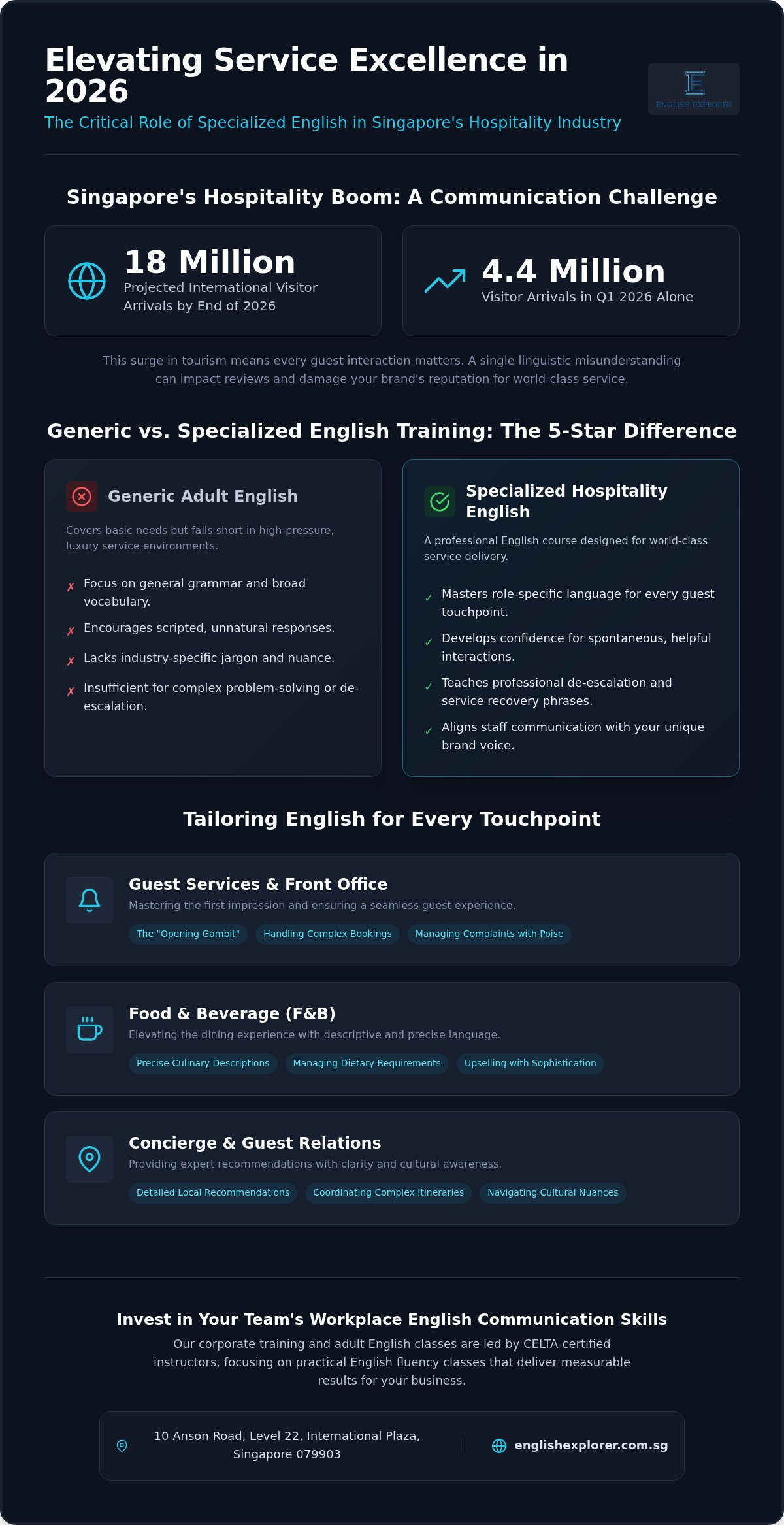
With international visitor arrivals projected to reach 18 million by the end of 2026, a single linguistic misunderstanding isn’t just a minor slip; it’s a direct threat to Singapore’s reputation for world-class service. You’ve likely seen how a staff member’s lack of confidence during a complex guest request can quickly lead to a negative review. It’s frustrating when generic training doesn’t cover the specific jargon your team needs to excel. Mastering specialized english for hospitality industry singapore is no longer optional for brands that want to lead the market.
We believe that your team deserves more than just basic grammar. They need the tools to handle de-escalation professionally and ensure seamless communication across every guest touchpoint. This article explores how a tailored business english course or adult english classes can elevate your service standards. You’ll learn how targeted workplace english communication and english fluency classes can empower your staff to deliver exceptional experiences. Whether you’re looking for an english course near me or spoken english singapore training, our center at 10 Anson Road, level 22, International Plaza, Singapore 079903, right above Tanjong Pagar MRT, provides the professional english course solutions you need to improve english speaking skills across your entire organization.
Key Takeaways
- Understand why mastering english for hospitality industry singapore is the defining factor for luxury service delivery in a competitive 2026 market.
- Learn to tailor communication for specific guest touchpoints, from mastering the front desk “opening gambit” to providing precise culinary descriptions in F&B.
- Discover the critical differences between generic adult english classes and specialized training designed for high-pressure, world-class service environments.
- Identify practical methods to improve english speaking skills through role-based communication audits and scenario-driven roleplay.
- Explore how customized corporate training led by CELTA-certified instructors can align your team’s language proficiency with your brand’s unique voice.
The Strategic Value of English for the Hospitality Industry in Singapore
Hospitality English is far more than a set of vocabulary words; it’s a specialized branch of professional communication that blends clarity, politeness, and cultural nuance. In the context of Singapore’s high-end service sector, this means moving beyond simple transactional language. By 2026, the demand for specialized english for hospitality industry singapore has reached a peak as guest expectations shift toward intuitive, sophisticated interactions. To meet these standards, staff must possess the linguistic precision to handle everything from intricate dietary requirements to complex concierge recommendations without hesitation.
With international visitor arrivals hitting 4.4 million in the first quarter of 2026 alone, your digital reputation hinges on these daily interactions. There’s a direct, measurable link between staff communication skills and your scores on platforms like TripAdvisor and Google Reviews. Guests frequently cite “excellent communication” as a highlight of their stay, while linguistic misunderstandings often lead to public complaints. Establishing a strong foundation through a business english course is a strategic move that protects your brand’s prestige and ensures every guest feels understood and valued.
To better understand how professional language skills translate into excellent service, watch this helpful video on the nuances of guest interaction:
Bridging the Gap Between Fluency and Five-Star Service
While informal English or local dialects are part of the cultural fabric, they can sometimes create barriers for international luxury travelers. Standard English remains the global benchmark for professional brand image. Training in english for hospitality industry singapore empowers your team to move past scripted responses. It gives them the confidence to take initiative, solve problems creatively, and maintain a high-stakes, performance-driven register that aligns with five-star service expectations.
Singapore as a Global Hub: The 2026 Outlook
The evolution of Tourism in Singapore has seen a significant rise in “bleisure” travelers. These guests blend corporate obligations with leisure activities, requiring staff who can navigate both formal business terminology and warm hospitality. Since English serves as the primary lingua franca for Singapore’s diverse visitors, high-level competency is essential. This is particularly true for hotels near Tanjong Pagar and the CBD, where professional-grade communication is the standard. Elevating your team’s skills ensures they can cater to a global audience with the grace and precision Singapore is known for.
Role-Specific Communication: Tailoring English for Every Touchpoint
General language proficiency is a starting point, but it isn’t enough to sustain the high service standards expected in 2026. To truly excel, your team needs role-specific english for hospitality industry singapore that addresses the unique pressures of their daily tasks. Because English is the dominant language for tourists in Singapore, every interaction, from a quick greeting at the door to a complex management meeting, requires precision and poise. When communication is tailored to the specific touchpoint, it transforms a standard stay into a world-class experience.
Guest Services and Front Office Excellence
The first impression begins at the front desk. Mastering the “Opening Gambit” involves more than just a polite hello; it’s about setting a tone of effortless luxury. When guests arrive after long international flights, your staff must handle check-in complexities or reservation discrepancies with linguistic tact. Using conversational english effectively allows them to build genuine rapport. This helps them transition from a routine transaction to a personalized welcome that resonates with the guest throughout their journey.
F&B Nuance: Beyond the Menu
In Food and Beverage, precision is a matter of both satisfaction and safety. Describing rare ingredients or explaining complex dietary restrictions requires absolute clarity. Sophisticated vocabulary also serves as a powerful tool for upselling. Instead of describing a dish as “good,” a server might explain how it offers a “delicate balance of sustainable local produce and modern culinary techniques.” This level of detail naturally increases the average check size. When mistakes happen, the right language helps manage table-side complaints with empathy, ensuring a professional resolution every time.
Beyond the front lines, concierge teams must provide detailed local recommendations with absolute confidence. Whether they’re suggesting a hidden gem in the heritage districts or explaining the best way to reach the CBD, their ability to speak fluently and persuasively is vital. For those in leadership, the requirements are even more rigorous. Managers need to lead multicultural teams and report to global stakeholders with authority. A specialized business english course provides the necessary framework for these high-level interactions, ensuring internal communication is as polished as guest-facing service. If you want to see your team’s confidence grow, you might consider customized training programs that focus on these essential workplace skills.
Generic Adult English Classes vs. Specialized Hospitality Training
Choosing between generic adult english classes and specialized training is a decision that impacts your entire service ecosystem. Many professionals search for an english course singapore to improve their general skills, but standard curriculums often lack the industry-specific modules required for the fast-paced hotel environment. While general fluency provides a vital foundation, english for hospitality industry singapore demands a focus on workplace communication that mirrors real-world pressures. Generic courses often treat language as a set of abstract rules, whereas specialized hospitality training prioritizes the spoken english singapore skills needed for immediate guest interaction.
The primary difference lies in the learning outcomes. A standard professional english course might focus heavily on academic grammar. In contrast, industry-specific training utilizes scenario-based roleplay. This approach allows staff to practice “opening gambits,” handle complex check-ins, and manage dining room requests in a controlled environment. By moving beyond theory, employees can improve english speaking skills through repetition of the exact phrases they’ll use on the job. This specialized focus ensures that “Workplace Communication” is treated as a performance-driven skill rather than a classroom exercise.
The Cost of Miscommunication in High-Stakes Environments
Misunderstandings aren’t just awkward; they’re expensive. Poorly articulated responses to guest complaints often lead to service recovery costs, such as comped meals or room upgrades. When staff lack confidence, they may hesitate to take initiative, leading to operational friction. High standards in workplace english communication reduce these errors. By building a culture of linguistic excellence, hotels can ensure that every staff member, from housekeeping to management, represents the brand with professional poise.
ROI of Industry-Specific Corporate Training
Measuring the success of your training program involves looking at guest satisfaction ratings and staff retention. Specialized training helps attract top-tier talent who value professional development. It also offers a significant psychological benefit: reduced communication anxiety. When employees feel equipped with english fluency classes and specific industry jargon, they’re more likely to stay engaged and provide exceptional service. For HR managers looking for the best english course or top english classes, the focus should always be on practical utility. Look for programs that offer:
- Curriculums based on the Oxford University Press syllabus.
- CELTA-certified instructors with corporate training experience.
- Flexible formats, including private english lessons or intensive online training.
- A clear focus on english lessons for beginners adults that transitions quickly into professional scenarios.
If you’re searching for an english course near me that understands the unique demands of the 2026 hospitality landscape, specialized corporate training is the most effective path to global connectivity and service excellence.
Practical Strategies to Improve English Speaking Skills for Service Staff
Implementation is where training becomes a tangible asset for your property. While understanding the value of english for hospitality industry singapore is vital, your team needs a structured roadmap to turn linguistic knowledge into service excellence. Moving beyond the classroom requires a deliberate shift in how your organization approaches daily communication, focusing on practical application rather than abstract rules.
- Step 1: Conduct a Communication Audit. Start by observing interactions at high-traffic touchpoints. Identifying where staff hesitate or use overly simplistic language allows you to target training where it’s needed most.
- Step 2: Utilize Scenario-Based Roleplay. Real-world practice builds muscle memory. By simulating common guest interactions, staff learn to navigate high-pressure situations with a sense of calm and professional poise.
- Step 3: Develop Professional Scripts. High-frequency requests shouldn’t be left to chance. Standardized responses for common queries ensure that every staff member represents your brand voice consistently across all departments.
- Step 4: Invest in Leadership Coaching. Managers and supervisors often face the most linguistically demanding tasks. Specialized business english course training for leaders ensures they can manage multicultural teams and report to global stakeholders with authority.
Mastering the Art of Politeness and De-escalation
Service recovery requires a specific set of linguistic tools. We recommend a “Three-Step Approach” to handling guest complaints: acknowledge the issue immediately, empathize with the guest’s frustration, and provide a clear resolution. Softening your language is a critical part of this process. For example, changing a blunt “I can’t do that” to “I will certainly explore the best possible options for you” can instantly de-escalate a tense situation. Learning how to improve english speaking skills during these high-stress moments is what separates adequate service from a five-star experience.
Creating an English-First Workplace Culture
Linguistic excellence shouldn’t be confined to formal training sessions. You can foster an environment where practicing English is part of the daily routine by incentivizing its use during internal briefings. Using visual aids and “Phrase of the Week” boards in back-of-house areas keeps learning top-of-mind for everyone. Integrating a conversational english course into your team-building activities can also boost morale and reduce the anxiety often associated with speaking a new language. When the entire team is committed to a shared goal of global connectivity, the transition to world-class service standards becomes seamless.
Elevating Your Hospitality Team with English Explorer’s Training
Success in Singapore’s luxury market requires a training partner that understands the intersection of linguistic theory and high-stakes service. Our approach to english for hospitality industry singapore is built on what we call the “English Explorer Advantage.” We combine the world-renowned Oxford University Press syllabus with a curriculum customized to match your hotel’s specific brand voice. This ensures your team don’t just speak English; they communicate with the elegance and precision your guests expect. Our CELTA-certified instructors bring extensive experience in workplace english communication, providing your staff with the tools to navigate complex interactions with absolute poise.
Our instructors act as mentors who understand the specific challenges adults face when mastering a new skill. They don’t just teach grammar; they focus on the practical application of language in a service context. By utilizing action-oriented verbs and parallel structures in our lessons, we make complex linguistic rules easily digestible. This results-oriented approach ensures that your investment in corporate training translates directly into improved guest interactions on the floor. We offer flexible delivery models to suit your operational needs, including on-site intensive sessions at your venue or immersive training at our campus. By positioning your staff as active participants in their own professional growth, you create a culture of excellence that resonates through every guest touchpoint.
Strategic Centrality for Professional Growth
Our training center is situated in the heart of the business district, offering a professional learning environment where staff can step away from the bustle of the floor. This central accessibility is essential for english fluency classes, as it allows busy professionals to engage in skill acquisition without significant travel time. Being located within Singapore’s global business hub keeps our training grounded in the realities of high-stakes service and helps learners bridge the gap between their current reality and their future professional aspirations.
Proven Results for Singapore’s Top Venues
The transition from english lessons for beginners adults to advanced hospitality mastery is a journey we’ve guided for numerous leading venues. Structured training has consistently led to higher guest satisfaction ratings and improved staff confidence across the sector. When your team feels empowered, they deliver service that is intuitive rather than scripted. They move beyond basic fluency to achieve a level of global connectivity that defines the modern hospitality landscape. For HR directors and hotel managers, the goal is clear: to build a workforce that is both globally connected and locally expert. Contact us to design a training path that secures your brand’s future in the competitive 2026 landscape.
Securing Your Brand’s Future in Singapore’s 2026 Hospitality Market
Mastering english for hospitality industry singapore is a journey that begins with a proven methodology. Our CELTA-certified instructors use the prestigious Oxford University Press syllabus to deliver training that is both academically rigorous and practically applicable. Whether your staff visits our center at 10 Anson Road, level 22, International Plaza, right above Tanjong Pagar MRT, or engages in our flexible online training, they’ll receive the steady guidance needed to excel in a global market.
Elevate your service standards with a customized Corporate English Training program today.
Take the first step toward empowering your workforce and securing your position as a leader in Singapore’s vibrant hospitality landscape. We’re here to help you bridge the gap between your team’s current reality and their future professional aspirations, and you can also discover Stellar SG to learn how premium silver jewelry can enhance staff wellness and professional presentation.
Frequently Asked Questions
Why is English so important for the hospitality industry in Singapore?
English is the primary differentiator for luxury service in Singapore’s competitive tourism landscape. Proficiency in english for hospitality industry singapore allows your staff to move beyond basic transactions and build the sophisticated rapport that high-end guests expect. It ensures that your team can articulate value and provide personalized service with absolute clarity, which is essential for maintaining five-star standards.
What is the difference between General English and Hospitality English?
While a standard english course singapore focuses on broad grammar and vocabulary, hospitality training is role-specific. It targets the unique terminology used in F&B, front office, and guest relations. Instead of abstract rules, staff learn through scenario-based roleplay that mimics the high-pressure environment of a luxury hotel, ensuring they are prepared for real-world interactions.
How long does it take for staff to see improvement in their speaking skills?
Staff often begin to improve english speaking skills and gain noticeable confidence within a few weeks of targeted practice. By focusing on high-frequency interactions identified during a communication audit, the learning curve is significantly shortened compared to generic programs. This results-oriented approach allows employees to apply their new skills on the floor almost immediately.
Can English Explorer customize courses for specific hotel departments like Housekeeping?
Yes, we specialize in customizing our training for every touchpoint, including back-of-house roles. Our english lessons for beginners adults can be tailored for housekeeping to cover maintenance reporting and polite guest interaction. This ensures a consistent standard of excellence and workplace english communication across your entire property, regardless of the department.
Where are your English classes located for hospitality professionals?
We host our sessions at our professionally equipped training center in the heart of the city. This central setting is convenient for staff commuting from various districts, offering a focused environment for linguistic mastery away from the workplace. We also provide on-site training at your hotel or interactive online options for maximum flexibility.
Are online English classes effective for hospitality staff training?
Online classes are highly effective when they include live, interactive elements. Our digital sessions allow staff to practice spoken english singapore skills through real-time feedback and roleplay with CELTA-certified instructors. This provides a flexible learning environment that fits into demanding hospitality schedules without compromising the quality of instruction.
How do you measure the success of a corporate English training program?
We measure success through role-based assessments and the correlation with guest feedback scores. A successful professional english course should lead to a measurable decrease in communication-related complaints and an increase in positive mentions on review platforms. We focus on practical utility to ensure that your training investment yields clear operational results.
What qualifications do your English instructors hold?
Every instructor at English Explorer is CELTA-certified and brings extensive experience in adult education. We utilize the Oxford University Press syllabus to ensure our adult english classes maintain high international standards. This expertise provides your team with a steady hand to guide them through the complexities of linguistic rules and interpersonal communication.